By Jey Sushil
Remembering my father
I thought I would not miss him. I was wrong.
He was a nobody. A reticent man who in his last days wanted nothing except a peaceful death. Much like with the rest of his life, he couldn’t find that peace. Writhing in extreme pain, his left side of the body swollen and a puss-oozing-boil near his rectum, he would scream at night, his spirits split between the will to live and the desire to die.
I never saw him in such a state. I was told this by others who tended to him on his last days. When I called on the phone, he would be quiet, occasionally sputtering a word or two. We had talked that day — the last day. I asked my elder brother, “How long?” “Maybe a day or two”, he responded. I couldn’t sleep and sat staring at my phone. In a few hours, a message blinked on my phone: Papa is no more.
I live in a different continent. Father knew that I would not be there for his last rites. He was content with that. He was content with his life. He was content with everything. He never asked me whether I would come after his death (for the final rites) or not. In the last two years, it was always, “I am tired. I want to leave (this world).”
~
Six months earlier, I met him in the village with my wife and son. An Indian summer: temperature rising to 44 degrees centigrade, no electricity, no rains. He was worried that his six-year-old grandson had developed heat boils within hours of arriving. It had been four years since they last met. His old eyes kept following the little one wherever he went in the open courtyard, asking us to keep an eye on him. There was no conversation, no hugs between my father and my son. Father was always shy of touching anyone, even babies. He never hugged me or touched me with affection. Maybe touch was alien to him. We never even saw father touch our mother affectionately at home nor in public.
I used to be like that a little bit, then my son taught me to love physically. When he wore diapers, he wanted me to clean his bum. He constantly asks for kisses and hugs. He sleeps with me holding my earlobes. That’s his favorite part of my body. I don’t remember what part of my father’s body I really liked. Maybe the right palm, the one he hurt in a factory accident years ago. It had an odd shape; it still looked a bit bloated in a way; the stich marks visible on the slightly wrinkled skin on the upper side of the palm. I never touched nor felt it. The accident happened at least three decades ago; a faint memory remains of mother feeding father with a spoon — an oddity, maybe that’s why it is etched somehow in my memory — his swollen black dorsal side of hand, white stiches on the metacarpal part of the thumb, fingers fatter than usual. Slowly the swelling subsided. His hand never recovered full mobility, but father could do his work — grip was important for the job he had. Sometimes he would make a fist and open it rapidly, a recommended exercise. At those moments, a strange sliver of hope could be seen on his face of regaining the full power of the fist. It never happened. His hands were not steady afterward. Frail and wrinkled hands of an old worker.
That summer, to fight the hot weather, father digs a shallow pit in the courtyard where my son is playing in the mud. The soft village soil will cool him. People have gathered around to watch a six-year-old boy who only speaks English and odd words of Hindi, a foreign-born jumping in the mud like a pig. Father watches grandson in silence. I am looking at father. The yellowish eyes, dry skin on his body, depleting biceps; they were powerful once, it seems he is about to cry but he doesn’t. He has this habit of looking in the void. I try to joke with him: You have to live longer. Your grandson is growing. He turns around and smiles at me, as if he knew my words were vacant. He tells me, “Ask mother to clean him.” Before cleaning him with the outside tap, I take a picture of my son who has become a large mud-cake. That picture sits on my desk. There is another picture — the only picture of three of us. Me, my father, and my son. I am in the middle. Father on left. Son on my right. They do not touch each other. I touch both. I am the bridge. I am the in-between, the immigrant, who had long ago left his parents and moved to earn his livelihood.
He’d long ago lost the willingness to enjoy life. And, even some years before that it seemed he’d made the decision to go quiet. The death was neither sudden nor due to old age. It was a long-drawn battle with life which he wanted to lose as soon as possible. It took him 30 years: a life of surrendering, silence, inaction, occasional outbursts, feelings of helplessness, until it finally came. In all that time, he never talked about death. He never talked about anything except a little bit about his work, only when prompted. The details he would give were messy and even we would correct information in his stories. He didn’t bother to contradict us: He would silently rub his tobacco on his palms when someone corrected him, and then it would take another round of cajoling to get him to tell us more. He would not utter a word, only a thin smile while mixing the tobacco with lime and then stuffing it under the lower lips. A ritual he had perfected at a young age. Then he would say a sentence or two before mother picked up the thread and narrated the story about him, as if he was a baby and needed reassuring. It is difficult to remember his voice now. Did he ever have a voice of his own? When happy, he would try to look busy, saying nothing, when angry he would not shout. He never tried to explain anything to anyone. For him, speaking meant three to four sentences and then expectation that we will understand. When I think of his voice, it comes interspersed with mother’s voice, dominant, convincing. Occasionally, I would push back but sometimes he would be the one to challenge mother: You know better than me about me…huh. It was a rare sight to see father chiding mother. A rare sight in the last 30 years. Before that, when I was a kid, it was a different story.
~
A different story.
I woke up hearing the abuses of my mother who was shouting at the top of her voice, fighting with our neighbor. It went on for a while. Mother is unstoppable when she fights. She can hold her own with her capacity to tear someone down, but the neighbor gave her a tough fight. While on the toilet, I listened to the shouting match between the two women. As I came out of the toilet and walked to the open door of the apartment, I saw father walking up the stairs, who back then was working night shifts. He looked tired and annoyed but didn’t utter a word as he crossed mother and entered the house. It was a one-room apartment on the second floor, sharing a verandah with neighbors. Mother kept shouting outside. My two brothers were still in bed. Father asked me, as I must have looked frightened, “Why are you scared? Come to me.” I followed him to the kitchen where he drank a glass of water. He had removed his shirt and unbuckled his belt. I was fascinated with the broad buckle that had a sharp pin in the end to hook into the leather. It was my toy when father was at home and took it off.
He had just started removing the belt when we heard the voice of a man outside. It was the neighbor’s husband who came to help his wife and admonished my mother. I couldn’t hear what he said but father slowly walked out of the house, and I followed. He stood there and looked at the two women and the one man, hurling insults at each other. After a moment he said to my mother, “Go inside.” No one listened to his words. His hands were on the belt which was still halfway tucked in his pants. He walked ahead and walked past my mother. The neighbor’s husband was still abusing. I froze. Now the belt had been removed from the pants; the sharp pin hanging down from the buckle, leather in his hands. He took a few more steps. I could only see his bare back. The neighbor’s husband stopped shouting and looked at my father. His hands moved; he swung the belt.
Kachchh
The soft sound of iron piercing the skull. A flick of the wrist and the belt was again hanging from his hands. The neighbor’s husband stood stunned as blood rolled down from his head, covering his forehead, nose, lips. His tongue tasted the blood and a shriek came out of his mouth.
Father turned around and grabbed mother by her forearms, dragging her to the door. I followed. Silence inside. Women and men clamoring outside. Father woke up my two older brothers and said calmly to my mother, “Make some tea.” He drank tea and left home rubbing tobacco in his palms. I followed him and he didn’t stop me. After a while he picked me up and carried me on his shoulders until we reached the police station. Then we returned home in the police jeep. Father made tobacco for the policemen. I must have fallen asleep in his lap. No one talked about what had happened afterwards.
The belt was in the bathroom. A drop of blood spread through the puddle of water on the floor. I opened the tap. The puddle was disturbed, blood vanished. I was reminded of that drop of blood recently when my son had an accident. My wife was cutting vegetables with a sharp knife, and he jumped on her excited. She raised the knife to avoid him, but his hand fell on the knife. Sharp cut between the ring and little finger. Blood oozed out. He was fine a few hours later, after a visit to the hospital, but the shock was unbearable for me. Blood that binds us can be alienating. Blood that binds us can be nauseating.
~
Father was a man of a few words. Either he did not like talking or it gave him more pleasure to talk with his hands. Violence came naturally to him. He had more faith in his hands than his tongue. It was a trait many admired about him. No questions. He could hit anyone without even blinking an eye. Once, he beat up the manager of the factory. When summoned by the senior officials and asked to explain, he simply said, “I didn’t like his face that day.” He lost two weeks’ salary and was transferred from the mines to groundwork in the mill where his extra benefits were slashed. Workers in the underground mines were paid more. He didn’t care. He was young and brash. Mother told us about these things after many years, when father was old and fragile. He would sit on a cot, listening to her stories about him, looking at the thin air. No reactions, no responses, no denials, no comments.
I remember one day he came home from the factory without his bicycle. He had recently bought the rickety bike second-hand and was quite fond of it. His shirt was torn and he was fuming. Words didn’t come out of him. Mother waited. Eventually my older brother asked about the bicycle, and he responded, “I beat up that bastard security guy. He took the bicycle and was not returning it when I asked for it.” That is weird, I remember thinking. In the evening, someone came to return the bicycle. Later we learned that the security guy took the bike as he had to urgently go to his apartment in the colony and when my father went to get it back, he joked that he wouldn’t return it. Father beat him up, thinking he was trying to steal the bicycle.
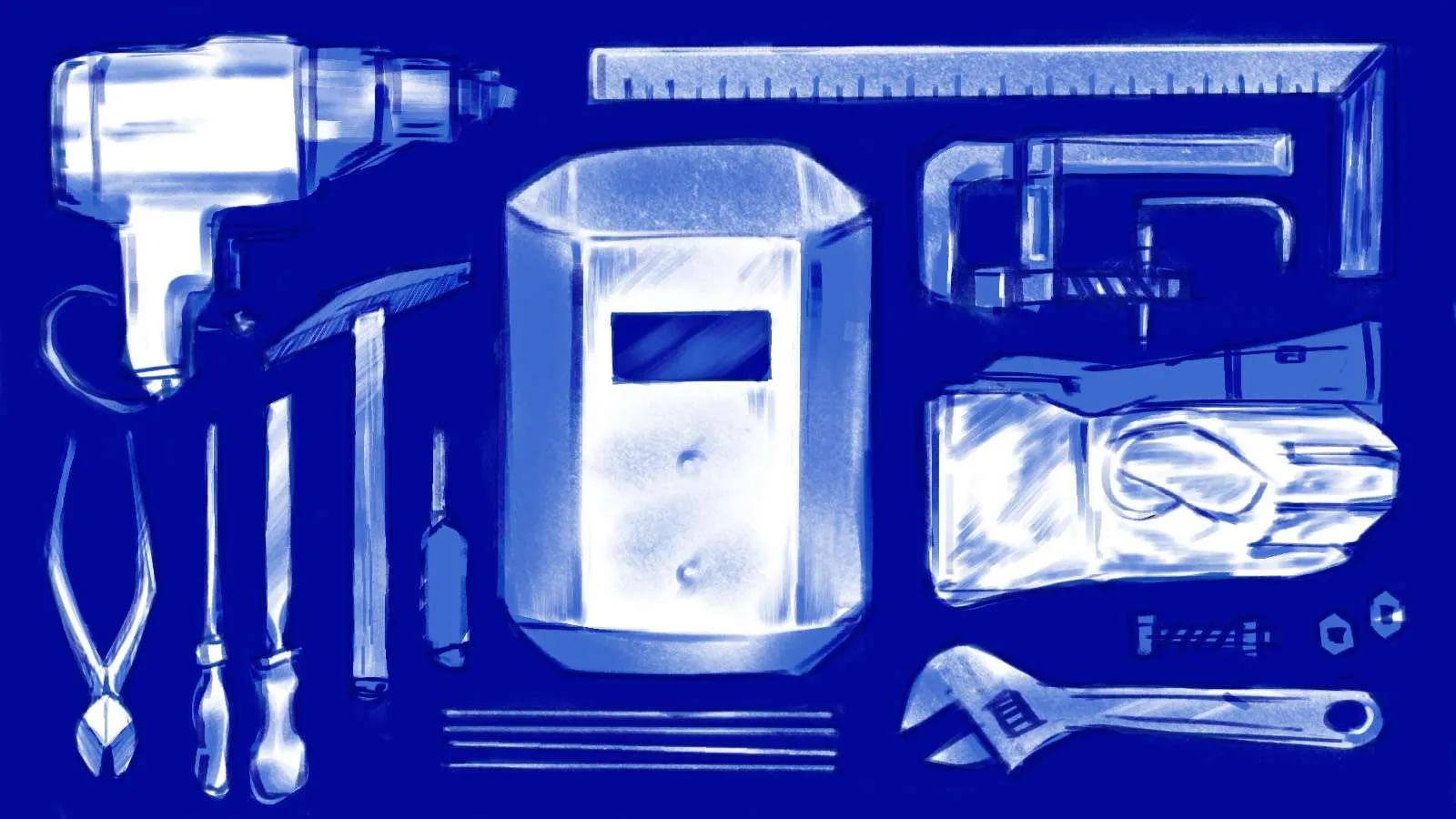
For him, beating was the solution for everything. Machines work this way. A little bit of nudge here, a bit of hitting there, tightening a screw, using the right oil, precise pressure, a bit of force fixes things. Life is like a welding machine. You need to know what kind of iron rod will work for the kind of welding one does. Thin, medium or thick. Which one will do the job of welding perfectly? For the rest, you must use some power, raw power. He never said that.
I am paraphrasing the words he had used at different points while explaining the work he did.
Memory works in strange ways. It was beyond him to explain his love for violence in a sophisticated manner. The words came randomly to him. Sometimes he would make gestures with his finger to show the size of a small nut and how to tighten it or use both his hands to show how he held the welding machine when working in an odd space.
Welding: It is like using a super-hot glue to fuse two metals into one solid piece. But instead of regular glue, welding uses intense heat and force to melt the edges of the metal. Once the metal cools down, it solidifies, creating a strong bond. There is no expertise, only the tolerance to extreme heat and sparks and a little knowledge of which iron rod will be suitable for what needs to be fixed. Father would emphasize force is needed to be a good welder. One of the rare things he loved talking about. I learned that much later when he was retired. His focus was never on the bond the rod makes, but on the process of applying force, the melting of the metal, and the pain of burning by fire sparks that he got some perverse enjoyment out of. It gave him satisfaction of doing hard labor. The joy of fixing something or building a structure by welding never occurred to him. He was not proud of the work he did but he liked what he did because that is the only thing he was trained to do and could do perfectly.
Occasionally he made things: a steel pestle and mortar, knives, incense-stick-stands, and would give them to his co-workers. No fancy designs. Hard, heavy, polished, shiny metal things. He made small knives for himself too, to cut tobacco leaves into tiny pieces so they could fit into the chunauti, a tiny metal box he had. At home, if we ever asked him about how he made those things, his constant answer was, “Why you want to know? That’s not the job you are going to do. You study, study hard. Be something.”
~
“What is your date of birth?”
He didn’t say anything.
“Papa, what is your date of birth?”
He kept rubbing the tobacco and lime in his palm and looked at mother helplessly as if she would save him from my questions.
I sat in silence, exasperated.
Then mother intervened.
“We do not know. In that era no one kept the dates.”
“Oh, but still which month, which year. Papa must have some idea about it.”
“Sometime in Sawan.” Mother gave me a month in Hindi. August it was.
“Year?”
“Officially 1945. That is in the company record but I do not know.”
Finally, father spoke, “My elder brother put it. 1st January 1945.” There had to be a date so that he could start working in factory.
“And when did you start working?”
“62,” he says, and I repeat — “You mean 1962?” He nods.
“How did you come to Jaduguda? To the factory?”
No answer.
Father is retired. He was always like this, not talking much, but I want to know more about him. When I became a journalist, father would come to visit once a year to live with me for a month or so. I used these occasions to learn a little more about him. The dynamics of father-son has changed — I have a job in a reputed media institution in Delhi and he is retired, lives in a village, and depends on me for money. I have become more talkative and do not hesitate to ask him anything. As a child, it was not possible in those days; parents, especially fathers, were reserved and kept things to themselves. He never changed. He doesn’t like these questions. He rarely liked questions. He seldom answered. An awkward silence always. I have been trying to learn more about my father before he got married to my mother. We have no knowledge about his life before the marriage except some snippets mother heard from her mother-in-law, who died many years ago.
We were supposedly talking, and I am still waiting for an answer to how he came to work in a factory in Jaduguda. He is meditating on his tobacco and gets up to go out for a walk. I grab his hand and make him sit. I have become a bit more physical with him in the last couple of months as some times he needs support to get up because of old age. He knows, I am not letting go. He asks for water and as I grab the bottle of water, he starts abruptly, “I ran away from my village and went to Kolkata. Later came to Jaduguda in ‘62. Got a permanent job in ‘65.” He concedes basic information, which is hard to line up with what mother has told me. There are gaps but no one is going to fill them in.
“Why did you run away from the village initially? Why you went to Kolkata? Why did you leave Kolkata?” Father is now looking over at mother again. No answer. After a while, he awkwardly says, “Why do you want to know these things. Everything happened a long time ago. I don’t remember much.”
I decide to change the topic, for no reason — my journalistic training maybe.
“How did you injure your palm?” I was a child when his right palm was crushed in the factory. I had faint memories of his hand wrapped up in a bandage and my mother feeding him for many days. I know the story. I still ask.
I can see a bright spark in father’s eyes.
“The right hand you mean.”
“Yes, yes.” I am excited.
“It was not my fault. I was working with my welding machine joining two pipes, and the other person had to balance the cylindrical pipe. As the pipe got heated, it slipped from his hand and fell on me, but you know what happened?” He is excited now that the welding machine has come up.
“What?”
“In one hand, I had the machine and in the other hand, I had the glass. The black glass you use to save yourself from the welding sparks. I was not wearing goggles that day. You know one has to use a rod for the welding. The rod was melting, heat increased, and the other person’s hand slowly started burning. He left the pipe and shouted but I could not hear. The welding is noisy, but I felt something and looked up. The pipe was falling on me and in a split second I tried to stop it with my other hand with the black glass. The glass broke and all the weight of the pipe fell on my hand. I fell and the pipe was on my palm.” He was breathing heavily, full of energy explaining that he saved the welding machine from breaking.
Seriously, I thought. More than 30 years after that incident and my father was proud of the fact that he saved the machine, rather than his hands, from injury. That was the way he was. The only thing in the world that roused his excitement was the factory and his welding machine.
“Papa, you put things together. Right? With your machine.” I had asked him as a kid.
“Yes, but you should study…” he never completed these sentences.
Now that he has left this world, I can only think of him as a welding machine.
~
Piecing together a complete portrait of him seems impossible because there is so much, I don’t know. Like most fathers of his generation, he didn’t interact substantially with his children. He never asked us about our days at school, our teachers, or any other details. Once a year, before the annual exams, he would ask me and my brothers, the three of us, “Do you need anything for exams?” We would ask for a new pen, ink, or occasionally a writing board, and he would get them for us. On rare days, he would come back from the market and ask one of us about this or that trouble we’d made but without any scolding. It was his way of making us aware that he keeps an eye on us.
He never hit any of us, not even when a teacher reported us. Unlike mother, who started in on a beating the second after a complaint reached her ears. Father might have slapped one of us once or twice in a year. These slaps were solid ones, delivered on our backs. His hands felt like iron slabs. He never slapped us on our cheeks, our head, or our stomach. I don’t remember a single beating now, except for one of his violent acts exhibited in full public view.
It was my oldest brother. He was about to get married. Everything was fixed, as happens in Indian families. An arranged marriage. But on the eve of the ring ceremony, he eloped with a different girl. Embarrassment followed by the ridicule and social ostracization of our family. We stopped getting invitations from our relatives and friends. This surely hurt father, but he kept quiet. His silence became much more pronounced. Before, he still talked a little now and then — but after that, his silence became stoic. He would go to the factory early in the morning, not even waking mother, not asking for tea. In the afternoon, he would eat whatever was given. The evenings, which he normally spent out at the market or seeing his friends, were turned into solitary walks in the small garden, with only the mud and weeds to look at. He would sit in the garden until it got dark, then come inside the house and sit in a chair. We didn’t hear a word from him for months.
Then one day, my brother returned with his wife, not to our house but to the house of his in-laws. Father didn’t like this. He wanted brother to bring the wife to our house. With some mediation, with some of my father’s close friends as witnesses, father and son met outside our house. I stood at a distance from them. My brother spoke for a while about his job and the extra responsibilities of being the eldest. After listening to him, father said, “You should either live with us or live somewhere else, but not in your in-law’s house.” My brother was young and in love with his wife and he loved his in-laws. He replied somewhat arrogantly, “My in-laws have done a lot for me. I am going to stay with them.” Father didn’t say anything. He rubbed the tobacco in his palms and put it inside his lips. He dusted his palms and said, “It means you won’t come?” Brother started a long sentence, “My in-laws…”
From where I stood, I could see the back of my father clearly and my brother’s limbs. Even before he completed his sentence…
Chhhhhatttak
Father had slapped him, but it was so quick that I couldn’t make sense of it completely. I heard the sound and saw my brother collapse onto the tar road. The swing and the sound still reverberate in my ears while I write this. Father turned and walked back to the house. His friends helped my brother up. Brother was shouting at the top of his voice, “This is the father I have who have no shame in slapping his eldest son.”
Father didn’t turn back. No one ever heard him talk about his eldest after that day. He didn’t even cry when my brother died in a motorcycle accident (ten years after the slap; he was 35). There was no reaction from him. He came to the place where my brother lived and performed all the rituals expected of him. He never talked about him ever again for the rest of his life.
~
He was an anomaly. He loved machines, but only in the factory. Once back at home, everything he tried to fix broke down. The leaking tap, the loose pedals of the bicycle, a faulty switch (those old black switches made of bakelite). Even putting a nail in the wall was an event leading to some sort of disaster. He would carry in all the tools he had to do a tiny job, and then the tap would become totally unusable, a chunk of the wall would fall out, the pedal would break off, and the switch . . . well . . . Every time he fixed/broke something we would watch in horror and wonder how he managed to work at a factory with all those big machines. His friends would tell us that he was one of the finest welders in the factory — he could weld standing up, sitting, and even laying down on the floor. Maybe he had shaky hands at home because he wasn’t used to such miniscule tools, with three kids and a wife hovering behind him, watching him.
Maybe, I inherited this trait — uncomfortable with domestic machinery. I still don’t know how to operate the washing machine nor the dishwasher. I prefer washing clothes and pots by hand like my father. I have, while trying to fix them, broken taps, bathroom curtains, failed to assemble chairs with the manuals, and many more. My wife laughs at me and warns: Do not try to fix. You will end up breaking them. My son is much better. He can change the batteries of his toy cars, make a perfect hole in the wall using his own tiny hammer, is almost an expert in fossil hunting and cleaning his small aquarium. One day he showed me how to use the surround sound in the car audio system. Like other children of his age, he can operate a mobile phone even though I tend to keep it away from him.
For my father, mobile phones were completely alien. He never had one. Mother kept the one mobile at home to talk to us. He had decided long ago that he would not talk on a phone, ever. The phone I gave him was cast away into some corner of the house where he never once picked it up. It was my illiterate mother who eventually learned to use the phone to talk to me and my brother. I once called, long before his sickness, and mother wasn’t available to pick up; I kept calling and he must have found himself with no choice but to answer. He picked up and words forcibly came out of him: “Hello.”
“Papa, it’s Sushil.”
“Are you listening . . . Babu is on the phone,” he immediately called out to mother, who was in the bathroom.
“Papa, I want to talk to you.”
“Hmmm.”
“How are you?”
“Good.”
“How is everything in village?”
“All good.”
“Any news.”
“Are you coming or not . . . Babu is on phone!” He shouted again.
Mother came and took the phone.
That was my father. An old machine afraid of tiny machines. Father is dead. Son has a whole life in front of him. Me — somewhere in between and that reminds me of what Orhan Pamuk has written remembering his father: A man starts dying the day his father dies.
A former multimedia journalist with BBC World Service, Jey has a bachelor’s degree in Botany and master’s and MPhil degrees in International Relations from Jawaharlal Nehru University (JNU), New Delhi. He recently published a serialized Hindi novel Diary of a House Husband for a digital app and an eBook of memoirs about JNU that has been translated in Gujarati, Punjabi, Urdu, and Bhojpuri as eBooks. Sushil has translated two books for Penguin India including A Turn in the South by Nobel laureate V.S.Naipaul. He co-heads a relational art project “Artologue” with his artist partner Mee Jey and collaborates in performance projects with her.
![“Art is [still] a Weapon”: A Brief History of the Protest Novel](https://beltmag.com/wp-content/uploads/2025/11/G20-protests-turn-violent-in-Pittsburgh-500x383.webp)