Pittsburgh activist Julia Whiteker bears witness for those disappeared by ICE.
By Jennifer Bannan
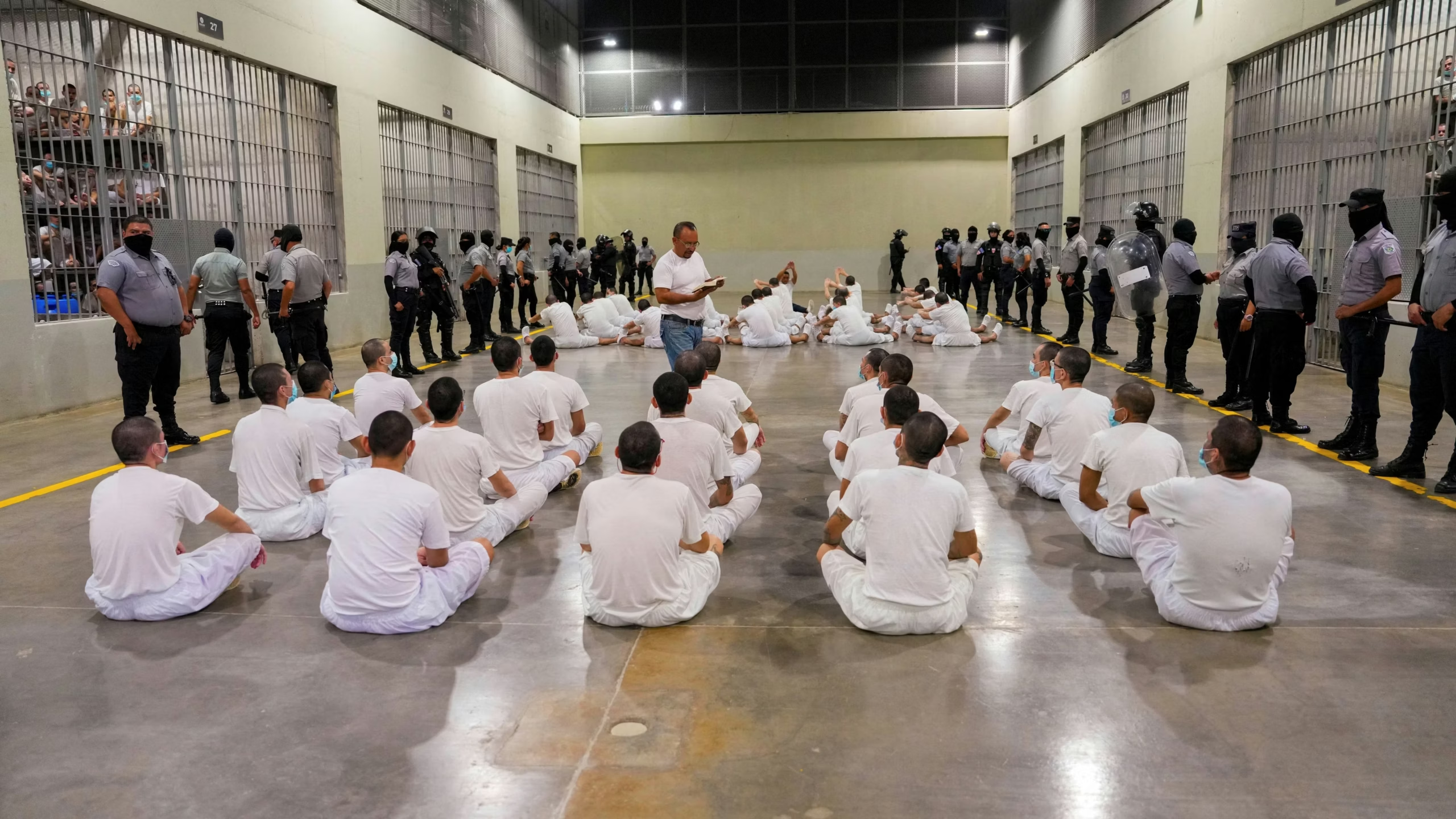
Was it the CECOT prisoners using the HT (Human Trafficking) hand signal of distress from behind bars, while Matt Gaetz toured for the cameras? Maybe it was the Venezuelans realizing upon the aircraft landing that, rather than being deported to their homeland where their families waited to greet them, they were being sent to a third country’s torture prison? Or maybe it was the young man whose temporary status was revoked days after an emergency lung removal surgery who was then deported to CECOT, leaving his mother unaware of if he was even alive?
All of these individuals, yes. But also, more than each story, it was the mothers. The way the mothers, as they spoke about their disappeared children, always broke down into tears.
Julia Whiteker is trying to explain to me what has been most striking about the work she has pursued since April 2025, gathering stories of “The Disappeared” to the notorious CECOT torture prison in El Salvador. More than 260 Venezuelan and El Salvadoran men shipped off with no due process, no warning to their families and no formal tracking of them in any government system.
By United Nations Enforced Disappearances Working Group standards, enforced disappearances are defined by the lack of a formal list of those deported and a lack of contact with family members.
By those standards, the men shipped to CECOT on March 15, 2025, March 30 and April 11 (and eight women, who were rerouted to US detention because CECOT doesn’t incarcerate women), were victims of an enforced disappearance by the government of the United States of America. In other words: kidnapping.
It would be five days before their names would be uncovered and posted by CBS. Months would pass before the group Anonymous was able to hack into the flight manifest and post more names.
With the release of the names, Whiteker, a Pittsburgh resident in the Regent Square neighborhood, felt a calling.
There are hundreds of ways people can get involved in pushing against the dizzying litany of current injustices, but the stories of these young men, mostly in their twenties, felt urgent to Whiteker. She has a son in his early thirties, but Whiteker’s sense of purpose also came from the loss of her daughter at age 32 to cancer, just three years after her diagnosis. Whiteker thinks of the cancer as her daughter’s CECOT — a torture prison. “I knew how these moms felt. That they’re crawling out of their bodies in terror. Because your job when you have a kid is to keep them alive.”
She dug in, helped by the fact that many of the disappeared had multiple given names. Only using Google, she could usually find some information about these disappearances, in the form of news reports, social media pages with pictures of the young men, urgent pleas from their families for help.
She understood why Kilmar Abrego Garcia’s story held power in the media – the government had admitted that he was deported “accidentally” against a specific judge’s 2019 order that allowed for his deportation but not to El Salvador. But the deportations for the others had just as many injustices and absurd arbitrary factors in the government’s justifications of their extraditions.
In batch form, these men are numbers. They are the 238 Venezuelans who were disappeared, or 252 if you include the subsequent batches. Or maybe you’re just interested in the 23 Salvadorans, who are still in CECOT. And there were new numbers to consider over the months Whiteker built The-Disappeared.com, as new statistics were made public, like how at least 50 percent (according to a CATO Institute report) disappeared had no criminal record in the US, or how 50 percent had entered legally and were going through formal residency processes, but were nonetheless disappeared.
Individually, though, they are stories. And with so many of them, Whiteker was sometimes working 20-hour days to gather and publish them. She started getting noticed. The League of United Latin American Citizens (LULAC) contacted her about the stories and published them verbatim on the LULAC site . Together and Free, an immigrant advocacy organization, also used The-Disappeared.com stories on their website and on social media. More exposure was promising.
And yet, where was the New York Times article? Why was Kilmar Abrego Garcia still one of the only stories told in mainstream media? Why wasn’t someone else writing about the other injustices, such as the randomness of using tattoos as a signal of gang membership, with no proof that such tattoos signify gang meaning? Slowly, statistics rolled out to confirm what she was finding in her research. A report in ProPublica, May 30, 2025, showed that only 32 of the CECOT deportees had been convicted of US crimes, mostly non-violent ones, including traffic offenses. Only six (Salvadorans) were convicted of violent crimes. For most, their crime was crossing the border, and many of them had never left a US detention center, had never even set foot on American soil as they awaited immigration proceedings. And then they were sent to a torture prison.
In the beginning of this project Whiteker drew her information from public sources such as social media and local news reports, but later she began receiving more calls from family members hoping for her help. Her Spanish isn’t great, so she enlisted Andrea, a neighbor she overheard teaching Spanish at Biddle’s coffeeshop. Originally from Mexico, Andrea (she agreed we could use her first name) moved to Pittsburgh with her American husband four years ago.
Andrea’s immigration status is current, but it feels tenuous anyway, given the disregard for the law that seems the central principle of this administration.
“It took me three years to get here,” Andrea says, of the lengthy immigration process. “I’m a permanent resident but my temporary green card is expired, my permanent 10-year green card application is in submission, and I only have a letter. The letter is supposed to ensure my legality 48 months beyond the expiration date, but I’m like a lot of other people I know who feel strange about that. We don’t want to risk travel, so we’re delaying going back to visit family.”
She doesn’t really think she would be accosted by ICE because she’s “not dark enough,” she says, acknowledging the racial profiling that the Supreme Court recently allowed under the Trump administration. Still, she teaches Spanish at a coffeehouse. Could that make her a target? She tries to avoid comparing herself to those disappeared, acknowledging her privilege. “I came here because I fell in love. Most of these people come because they’re not getting enough to eat. They have no other option.”
Drawing from her own experience, Andrea is uncertain how anyone without means makes it through immigration to citizenship. “You have to keep paying the lawyers, you have to prove you’re not using any assistance. I couldn’t work the first year I was here, waiting for my working permit. If I hadn’t had my in-laws, I’m not sure how I could have survived, and even they were hassled, investigated to be sure, about whether at some point I would need social assistance. “
Andrea doesn’t feel particularly hopeful. “If we don’t care about killings in Gaza we’re not going to care about some immigrants,” she says. “Still, it’s terrible to hear the moms say things like, ‘I don’t want to eat because I wonder if my son is eating,’ or ‘I’m not the same person. Even if my son comes back, my life is ruined.’” Andrea agrees with Whiteker that the moms are the most heartbreaking part of this story-gathering work. “The sisters or brothers are intense, they have all the paperwork, they keep making the calls and gathering the information. The wives or girlfriends are despondent but they’re also focused on survival for themselves and their kids. The moms are just destroyed. They always break down crying.” Listening to all that pain makes Andrea, who is in her thirties and has thought about having kids, wonder if it makes sense to bring a child into such an uncertain world.
The-Disappeared.com stories are taking shape beyond the CECOT focus. A Russian family in ICE detention, their eight-year-old in foster care, is waiting through the slow process of asylum. A Tunisian married to an American citizen, who once overstayed his Visa, but is otherwise a person whose immigration path is an almost exact replica of Melania Trump’s. And there is the 67-year-old who in his 50s escaped Iran and then Turkey’s Islamist repression, was detained by ICE in June, and now awaits final deportation from an Indiana prison to Sudan. A death sentence, his family says, unless their appeals efforts are successful.
Mostly, though, in that first batch sent to CECOT, what Whiteker can’t believe is how young and innocent they are. Just kids. Just trying to get away from places where it was impossible to make a living, hoping to live a life that wasn’t completely destitute. And then made into theater, mere puppets in the play of Homeland Security and ICE. And their families treated as meaningless, only learning what became of them because of that theater. Many of the stories involve family members spotting their loved ones on Matt Gaetz videos touring CECOT, able to identify them by their voices and faces.
Along the way Whiteker has met others like her, including Cecilia Mallard, based in Massachusetts, who posts on TikTok with the name Marigold0007. Her take on the disappeared is similar to Whiteker’s. They are “sweet innocent boys.” When she first began documenting their journeys, she’d skipped over a story about a kid named Nixon, who had been detained by ICE in September 2024. “I just thought, oh, he’s Tren de Aragua. I only want to focus on the innocents.” All the news coverage related to his story showed Nixon and his brother Dixon in their orange suited mugshots and had headlines like “Gang Members Detained.” The headlines ignored due process, too, scrapping the word “alleged” while asserting that the brothers were part of Tren de Aragua.
When Cecilia gave Nixon’s story another chance weeks later and started digging into records and accounts from family, she learned that “his crime – tampering with evidence from an actual shooting – had been because he and his brother made the mistake of cleaning up a playground. His family said that the boys were very loving to the little kids in the community and didn’t want the kids to be frightened by the shell casings. They weren’t part of Tren. They watched the community kids while waiting for their work permits.” Nixon was deported to CECOT while he was awaiting trial in the tampering case.
Mallard had 200 followers when she began the work. Now she has 12,500. Mallard isn’t sure how her work can be considered partisan, even though hateful comments usually come from rightwing respondents. “I’m angry at Obama and Biden over this. ICE has become separate from whoever is president. People without records get swept up in these brutal practices that serve only private prisons. They move them every week or so between Louisiana, Florida, Texas. The prisoners get paid a dollar a day to make products – basically slave labor – and are charged $5 for a phone call. The food is inedible, the use of solitary confinement is common, some women in ICE detention have said they were given medications that caused miscarriages.”
Many people who were shipped to CECOT were first detained during the Biden Administration, underscoring the fact that immigration detention practices have been problematic for years.
“Some of the people responding to my posts complain that these kids broke the law in how they crossed the border. Many crossed legally, by appointment and through a legal crossing. But even if they didn’t follow the rules exactly, that’s a civil offense,” she said. “If they can brush off the E. Jean Carroll case [that convicted Donald Trump of sexual assault and defamation] on the grounds that it’s a civil case, then they need to stop with the double standard. Trump said he would deport the ‘worst of the worst’ and these people are not that.”
It’s as though Trump really meant to reference the conditions of the detainment, when he said “worst of the worst.” Detaining immigrants continues, and now Trump and his administration are murdering Venezuelans in the Caribbean, with no proof of criminal activity and, yet again, no due process.
Like Whiteker, Mallard says the families she talks to are relieved to find someone to share in their desperation. They aren’t concerned with how she was inspired, although sometimes she tells her story. She had a dream that she was at a summer festival with fairy lights and an empty stage. Ruth Bader Ginsberg handed her a broken microphone. “Do you want me to fix it or speak into it?” Mallard asked. “Both,” RBG said. Mallard has noticed that the families seem to think it’s totally natural to be inspired by a dream –this acceptance makes the work less difficult.
Whiteker has written 84 CECOT profiles and ten ICE detention stories. The Facebook page for The-Disappeared now has 39,000 followers. Today, Whiteker is no longer able to monitor all the comments. Sometimes she’s asked by family members of the disappeared to take down a biography or post, because the comments are so cruel, or because of concerns about being targeted. She is still trying to understand how so little is being done in mainstream media to elevate these stories. For now, the public has her site, sites like hers, and the occasional US regional and South American coverage, and not much else.
Are women more likely than men to take on the role of witness? Whiteker looks sad when she admits that most of the loved ones she speaks with are women. This is hard work, and it’s painful. And maybe men don’t want to be involved with a project that is so likely to end up with failure or sadness, she says. Or maybe it’s just that women are harder to pick off the street – many of them staying in their homes with kids. Men usually work outside the home and can’t take as much risk.
“We’re paying $6 million per year for the kidnappings,” she says, referring only to the CECOT arrangement with Salvadoran President Nayib Bukele. Homeland Security’s budget for immigration enforcement was $2B in 2025. The Big Beautiful Bill allocates $170B over four years for immigration enforcement, which could mean more kidnappings “How are these kidnappings different from what Hamas did to Israel?” How is there not more outrage?
Detention management statistics released Aug. 29 from ICE showed a record 61,226 people are being held in ICE facilities. New numbers from the Trump administration released on Sept. 26 showed that 70% of immigrants in ICE did not have criminal convictions.
As of July 18, the Venezuelans are finally back home, because President Bukele became disturbed by the public relations nightmare on the international stage, and because of prisoner swap deal-making between Venezuelan President Nicolas Maduro and Trump. Whiteker is taking a break, doing some travel with her husband who has been worried about her wellbeing.
But there are still stories. Namely, the stories of the Salvadorans who were unjustly deported to CECOT and continue to be in detention without due process.
This September, the most famous of the disappeared, Kilmar Abrego Garcia, was shipped to Pennsylvania, to the Moshannon Valley Processing Center in Phillipsburg, while the administration decides whether he’ll be deported to a third country. He remains at Moshannon as of this publication. The government has requested delays in providing evidence to the courts, blaming the government shutdown from earlier this year.
Meanwhile, mothers continue to suffer over their missing sons. And ICE continues to add to the numbers of detained. We can only hope that the work of Whiteker, Mallard, and other advocates will prevent the disappeareds’ stories from being drowned out.
Whiteker’s latest project is to understand what happened to a Chinese six-year old. He was disappeared Nov. 26, 2025 when he and his father reported for their ICE check-in in New York City. His father is in the ICE detention reporting system, but the child’s whereabouts are not being reported by the U.S. government.
Note:
- If you are looking for a loved one who has been arrested by immigration officials, the National Immigration Law center recommends its guide, How to Find a Loved One after a U.S. Immigration Arrest.
Jennifer Bannan is an author based in Pittsburgh with her husband, Sean Eckenrod, and son, Cypress Bard. She has had stories in the Autumn House Press anthology, Keeping the Wolves at Bay, and has been published in literary journals including the Kenyon Review online, ACM, Passages North, and The Chicago Quarterly Review. Her nonfiction has appeared in The Millions, Los Angeles Review of Books, and The Washington Post.