By Sharon Dilworth
Stewart O’Nan is the kind of writer who can get his readers to care about the closing of a chain seafood restaurant in a run-down mall in the middle of America. In his best-selling novel Last Night at the Lobster, Manny DeLeon, who manages the doomed dining establishment, starts his last shift like a general anticipating a battle he knows he will lose. DeLeon is still devoted to his job and feels responsible for failing his troops, though he is weary after so many years in the trenches. There will be casualties, the few survivors will be transferred to the nearby Olive Garden, but others will simply fade into a suburban oblivion when the Red Lobster locks its doors for the final time. Resonating with quotidian disappointment, we still end up hoping that the restaurant might stay open, and that his characters aren’t forgotten.
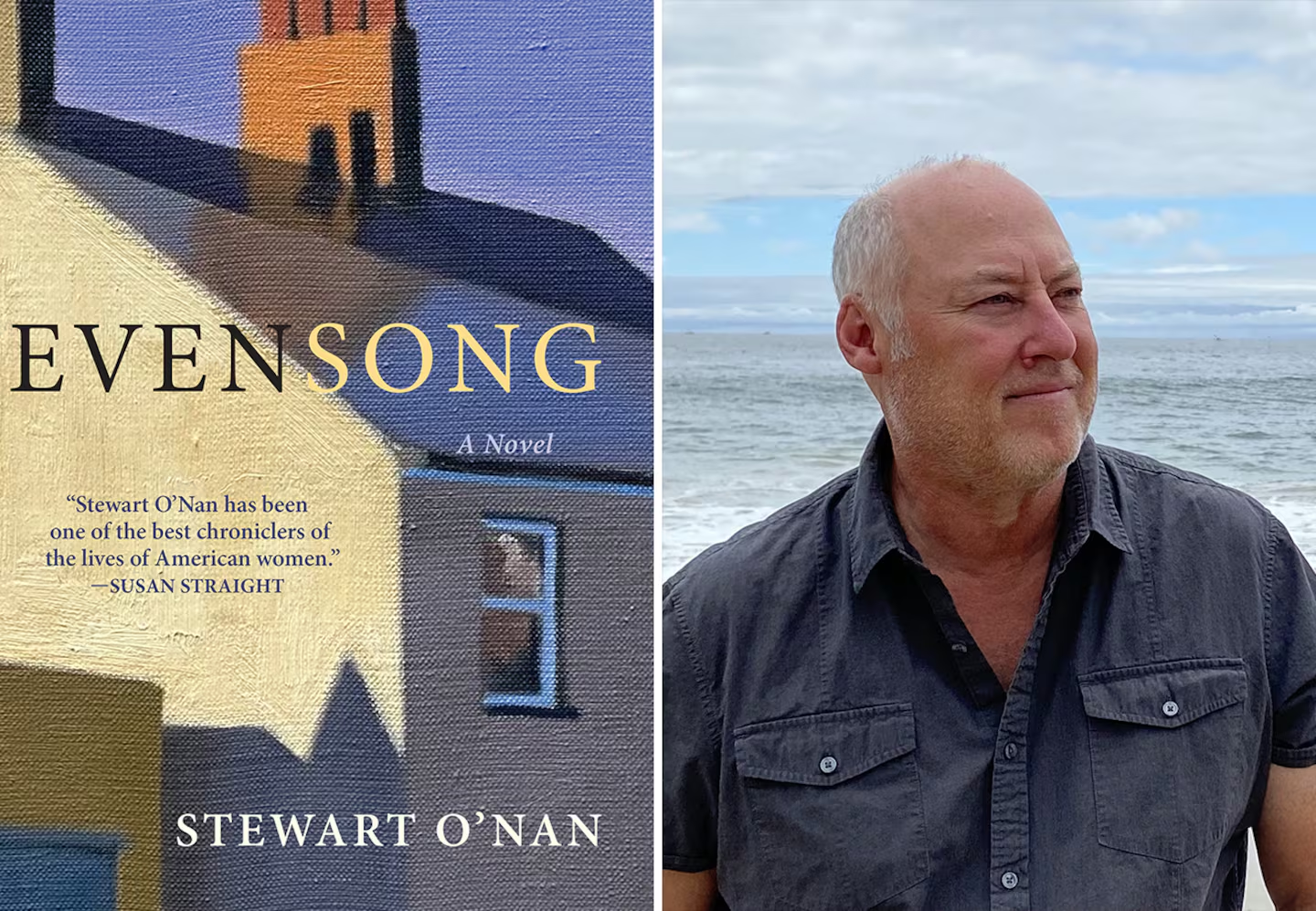
In O’Nan’s latest novel, Evensong, we become reacquainted with characters from O’Nan’s previous Pittsburgh novels even though years have passed. Not everyone, of course – O’Nan has written 19 books – but it’s as if we have unexpectedly run into an old colleague or friend, and time is suddenly catching up with us as well.
The octogenarian Emily Maxwell, for example, is a member of the Humpty Dumpty Club, whose members assist one another with everyday chores that have otherwise become too difficult to manage. An all-women squad of good will and helpfulness,
they go grocery shopping, get people to their doctor’s appointments, deliver medications, visit the ailing and finally get everyone to funeral services. Emily was enticed into joining not so much by the acts of charity but because of the club’s bridge games. Like the other women in the club, she is widowed, lonely, and not sure what to do with herself anymore, and the Club provides company while making the women feel that they are still needed and necessary.
The novel opens with an accident. Joan, the president of the Humpty Dumpty Club, has a great fall down her basement steps. She was wearing slippers (always a no-no at her age) and was taking out the garbage, something she should have had someone else do, especially when suffering a cold. So she’s taken to Shadyside Hospital, and from there she’ll be transferred to Longwood Retirement Community out in Oakmont. Emily – never an optimist – suspects that Joan will never walk again, in spite of the doctors’ optimistic prognosis that she can have a full (if difficult) recovery. All the king’s horses and all the king’s men. . . .
Anyone with older relatives or aging friends understands the severity of a fall and broken bones at this age. O’Nan reports that while the inspiration from the novel might have come from caring for family members he can now personally relate to the experience: “A couple of months after I’d finished the book, I fell down a flight of stairs and no one else was in our building and ended having surgery and doing PT for ten months just like Joan.”
As to why he returned to writing about Emily, O’Nan explains: “the first time was because I felt I hadn’t told her whole story, and I also wanted to check in on her and see how she was doing on her own a decade after Henry had died. This time I thought I might finally be telling Arlene’s story, but during a conversation I heard about the Humpty Dumpty Club and decided to do an ensemble piece instead. Starting a book with a firm grasp of my characters (and their entire pasts) lets me be more confident in their choices and their attitudes toward everything that comes their way, and gives me more time and space to learn about my new characters. It also helps with establishing character contrast.”
Emily isn’t a Pittsburgh native, but she’s been in the city long enough to mourn the disruptions of her East End neighborhood. Old landmarks and businesses are gone, people have moved, and things are not as familiar as they once were. She gives directions like a local– naming the establishment that used to be there as a touchstone, as in: “turn right at where the ugly blue Sears used to be,” which has an echo of both nostalgia and regret.
Her devotion to her adopted city of sixty years is heartfelt. “Pitt’s gothic Cathedral of Learning still seemed impossibly tall, the oak paneled stone fireplaced rooms palatial, too good for students like herself. When she took her grandchildren on the Incline, she was just as awestruck by the view of the point as Ella or Sam.”
Reflecting on the new condos at Bakery Square, Emily misses the old Nabisco Factory: “The real shame was the winter or summer, when the plant was running as you drove by you could smell them baking even with your windows closed. “They made Ritz crackers, and the warm buttery scent surrounded the place like a cloud.”
Emily’s sadness at losing her landscape is also commensurate with the loss of her husband, family, and friends. She and the other women in the Humpty Dumpty Club are aware that night driving is dangerous, that time is not what it once was, that the city they live in changes with every passing day and that they only dress up for funerals. They navigate these losses with humor and courage, and a great deal of judgement. O’Nan sees the inevitability in this: For Emily, as for us, she has her golden memories of the city and mourns all the places she’s lost. Every city is about change—even Pittsburgh, which for so long we thought of as stuck or static.
O’Nan is not an easy writer to categorize. In 1993, he won the Drue Heinz Award from the University of Pittsburgh for a short story collection, In the Walled City. The judge that year was Tobias Wolff, who praised O’Nan’s writing: “O’Nan has the rare gift of shifting perspective, often in the same story, without any sacrifice of intensity or authenticity. In this book we see life through the eyes of—among others—a ruined farmer, a black day-laborer, a young cop separated from his family and descending into madness, an old Chinese grocer; all of them vividly alive and different from the rest, yet mysteriously joined by the author’s feel for the weight of the histories they carry.”
This shifting perspective and the use of so many different kinds of characters perhaps define his career best. He has published several novels whose protagonists range in age from teenage boys to 80-year-old men. He had written a novel about the writer F.
Scott Fitzgerald and a screenplay about the poet Edgar Allan Poe. He has written a book about baseball with Stephen King. as well as a non-fiction account of the Hartford Circus Fire of 1944 which killed 167 people and remains Connecticut’s deadliest disaster.
“My early work could be violent and dire, which I think may have come from my reading, a mix of horror, sci-fi, and more extreme literary writers like Flannery O’Connor and Albert Camus. After interviewing scores of seniors for The Circus Fire, I became more interested in endurance, how people carry on even in impossible situations. Where do we find the strength to keep going? Because most of us do. I see that strength in Emily.”
Over the years, O’Nan has been compared to a number of other writers – Andre Dubus, Sherwood Anderson, even Edith Wharton. It’s a wide range of styles. He acknowledges the differences: “All fair comparisons, depending on the book. I try to match the style, structure and tone of the work to the character in order to get their emotional world across to the reader as powerfully as I can, so the means change from book to book. For EMILY ALONE, the Times compared me to Henry James, who seems to me as far from who I am as a writer as possible, and yet they were dead-on. The books aren’t about me as a writer, they’re about the characters.”
Pittsburgh remains O’Nan’s hometown, and with Evensong, the city becomes one of the novel’s protagonists. In writing for a Pittsburgh audience, he recognizes its essential connection: “Pittsburghers share a shorthand language and a secret world. When I say ‘The Dirty O,’ it’s not just words, it’s a feeling.”
Sharon Dilworth is professor of creative writing at Carnegie Mellon University in Pittsburgh. She is the author of three collections of short stories and two novels, most recently To Be Marquette published by Carnegie Mellon University Press.