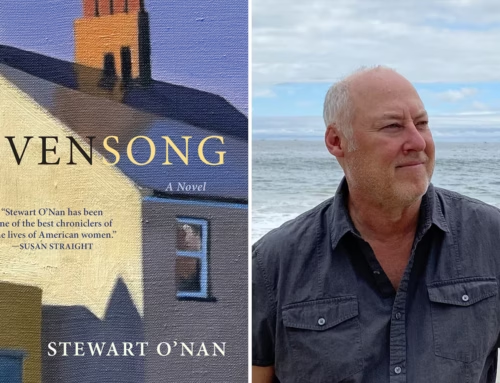
By Aodhán Ridenour
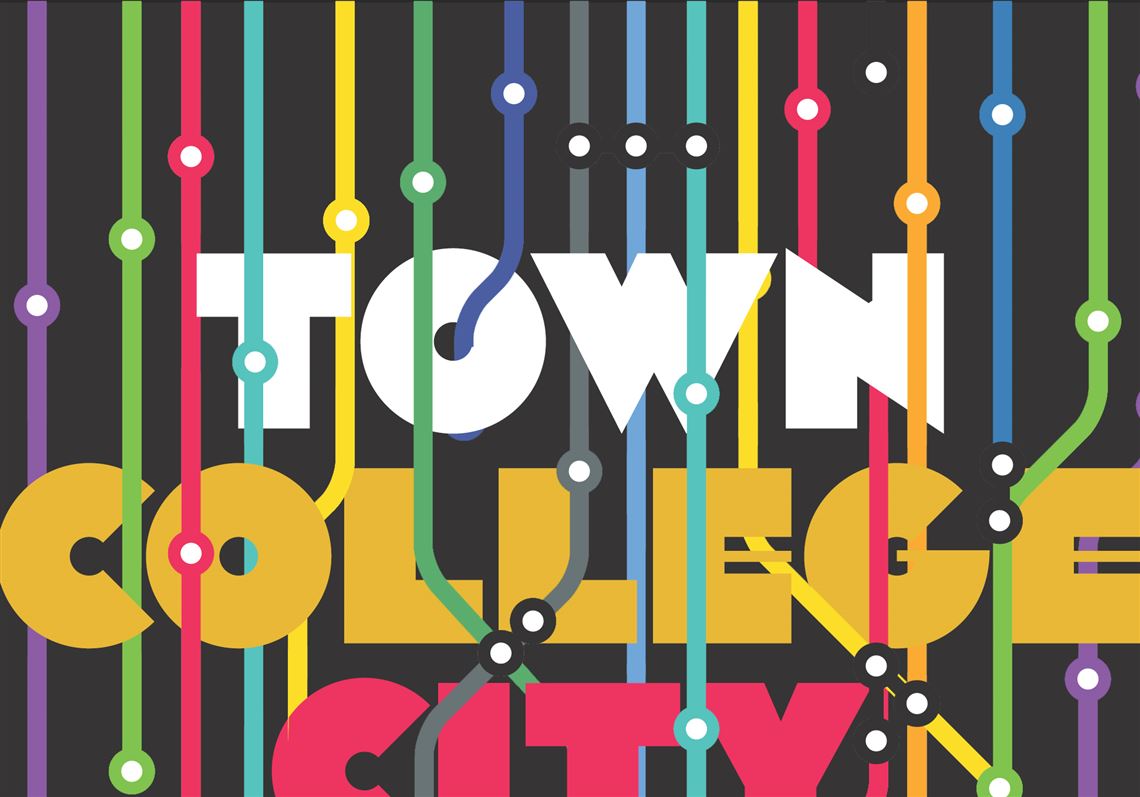
Town College City Road’s expansive arc is right there in the title. Patrick McGinty’s second novel follows protagonist Kurt Boozel from his insular hometown in Mercer County to college in middle PA, to the skyscrapers and mergers of New York City, and finally onto a mysterious Westbound road. McGinty’s precise depictions are in equal parts surprising and edifying as readers come to know Kurt—and Kurt, in turn, comes to know himself.
Tagged “a queer Rust Belt coming-of-age,” McGinty reveals notions of unsung regional experience and perspective. “I really loved trying to craft a narrative voice that was distinctly recognizable across time yet that also changed and grew in organic ways.”
McGinty’s linguistic functions are utilized repeatedly by the time Kurt arrives in New York City, where the protagonist’s mathematical bent feeds his timely obsession with cryptocurrency. For Kurt, crypto underscores his egregious social distrust and latent romantic desire, causing readers to wonder what is truly important in the complex algorithm that is Kurt Boozel. For McGinty, “that is the story of crypto more broadly–what’s it solve?”
A Zillennial myself, Kurt and I share the same age. His problems and priorities are familiar yet feel bizarre and newly mined in McGinty’s inventive language. “What I think I finally kind of unlocked in this book, though, is the ‘when’ for this language-forward approach.” In practice, the original ~1000-page manuscript was reduced to 500, then fewer as editors applied their various theorems, resulting in the novel available September 30th, 2025, from the University of Wisconsin Press.
Our conversation took place via a shared document across the Allegheny River from two old steel towns. The interview is edited for length and flow.
PRoB: It is a linguistically inventive book. As in, you bend words to make them new (i.e “hoggy bats,” “Whited and larval”). What was your motivation for handling the language like that, instead of using “canned phrases”?
McGinty: On pretty much every first draft my wife ever reads, she makes ten thousand notes that all say: “what does this even mean?” The editors of my first book (and now this one) have also joined the ‘what does this mean’ club. I’ve just always been language-forward when I draft—trying to write sentences that have never been written, to make the sentence the event—and so my attitude for much of my life has been ‘well, I’ll yield to ‘clarity’ at certain moments in the revision process.’
What I think I’ve finally unlocked in this book, though, is the ‘when’ for this language-forward approach. I’m glad you chose two small phrases from Part 1, “Town,” because that’s where I’m really thinking, ‘ok, let it rip—the language should communicate coming-of-age and pastoral and sexual awakening and so on, then character choices and outside forces will gradually crank down the over-the-topness in the language.’ In some ways, the book is just about a character’s attempting to recapture the language from Part 1, which I relate to very deeply and is probably my ‘motivation for handling the language like that’ for example, trying to see the contemporary world in front of us with the same all-sensory energy that colors our most vivid childhood memories.
PRoB: The arc of the book is laid out in the title, and I found that the narration becomes more cohesive and mature as Kurt matures. In what ways were you thinking about Kurt’s age in reference to the narration style?
McGinty: I really loved trying to craft a narrative voice that was distinctly recognizable across time, yet that also changed and grew in organic ways. I have such remarkably fond memories of revising what I came to think of as some of the ‘echo scenes’ in the book. As an example: there are recurring scenes in each part where there’s a physical fight or struggle of some kind, and I loved sort of hanging up those scenes like photographs drying in a dark room and working to make them feel of a piece while also capturing the tone of each one’s specific narrative era, whether that was the rollicking, exploratory style of College, the burn-out, work-a-day tone in City, and so on.
PRoB: One consistent mechanism was the use of ‘=’ signs throughout, which are resonant with the mathematical topics and help us see how Kurt views the world. Did they come naturally when they did?
McGinty: I didn’t figure out that little move for a long time. I revised this book for a period of 13 years. Original versions were close to 1,000 pages long, and so part of the revision process was to compress—not just cut lines or scenes, but to really work in an almost actorly way at inhabiting the voice more gesturally, so that the narrative didn’t need the same amount of explanation and reflection from early versions. I think it was in year 9 or 10 that I landed on the equations stuff—I felt incredibly familiar with the protagonist’s point of view by then. And the more comfortable and natural I got at representing the sort of daily whir of his brainy calculations, the more I tried to show him shifting into a harder kind of moral calculus with them, though such a pivot is always easier said than done.
PRoB: The story’s timeline regarding cryptocurrency is super relevant right now with Bitcoin valued at over $100,000 per coin. What does the gap between the story’s writing and its publication do for the story in your opinion?
McGinty: I spent a hilarious/depressing amount of time trying to figure out when and how to graft my novel’s narrative timeline onto Bitcoin’s real-world timeline. I feel good about the choice to end during the Dec. ‘17 Bitcoin spike, and I suspect there will be some crypto-literate readers who will think: “wow, the protagonist made a really smart decision based on what happened in the next 1-6 months.” Or: “Wow, the protagonist made a really dumb decision based on what would happen in the next ten years.” That kind of retrospective analysis is possible because of the ‘gap’ you speak of, and I wouldn’t say I discourage readers from doing that kind of quick math on Kurt’s behalf. One early reader said to me “I’ve never fully understood all this crypto stuff, but I really, really do not like what it does to Kurt,” to which I responded: you are the ideal reader for this book.
But it’s also kind of pointless math, because here’s the thing about crypto and Kurt Boozel: does his crypto hobby help him mend his relationship with his family? Does crypto help Kurt figure out whether he belongs in a ‘Town’ or a ‘City’ or perhaps a ‘College’ setting? What about his sexual identity? His attitude toward religion and class and region and family and literally…anything?
In short, what problem does crypto solve for Kurt Boozel? To me, that is the story of crypto more broadly–what’s it solve? I get why it’s enticing to people, because I was once enticed in a post-Occupy-Wall-Street-we-need-to-rethink-modern-finance kind of way. But what problem is it solving, specifically, for Kurt Boozel? The crudest reading of Town College City Road is that crypto helps enrich an already well-off banker. There’s a lot more to Kurt’s backstory that complicates that simple reading, but it’s also a rather damning and accurate assessment of who crypto has benefitted.
PRoB: Once Kurt gets to college in Part 2, I felt the “wisdoms” of the book became very, very insightful. Such as the conversation with Big Hick at dinner. Then life as a financial analyst in Part 3. Did these insights come from the writing itself or from another source?
McGinty: Many sources. I am a pretty chatty person, but I am also highly attuned to moments where someone peels back the curtain for me i.e. “Oh, I should shut up and listen.” And what I get in these moments isn’t some kind of philosophy or career path I want to ascribe to necessarily, but often a core, unfiltered distillation of someone’s perspective into ‘how things really work.’
A very important reason that I can be present for (and write about…) these conversations at all is that I am a novelist and not a journalist. When writing my first novel about driverless cars, I realized first how relentlessly dependent I was on journalism about the driverless car sector. Secondly) how ineffectual journalism was in the face of a sector absolutely rife with non-disclosure agreements (NDAs), and so I just got really, really good at meeting with people, asking questions, listening, then five years later, having some of that stuff show up in a character’s mouth.
Journalism remains a necessary, challenging genre to wield against the tech sector, but I very much believe that fiction needs to be part of not just a cultural diet but a political one, too. I don’t think we have fully reckoned with what a remarkably anti-democratic force the NDA is and how it skews every piece of nonfiction we encounter, and so I try to combat that a bit in my fiction.
PRoB: On a similar note, you, as the author, are not apparently queer. What were the challenges of writing a queer character as an apparently straight author?
McGinty: My grandpa was a steelworker who painted a lot; pretty much everyone in my Irish-Catholic family has 5-10 of his Western PA landscapes. When I was little and would paint next to him, he’d tell me: ‘draw what you see, not what you think you see.’
That’s a core artistic principle for me–drawing what I see, observing. It’s probably why so much of my work has unexpectedly gravitated toward the tech sector, simply because it is what has become so visible in Pittsburgh.
Drawing what you see gets trickier when you’re talking about people as opposed to industries, though. What’s appropriation? Who owns a story? I’ve had five gay roommates across my life and spent two decades living with young gay men as they came of age alongside me—their specific stories are not mine to tell, and I don’t tell them in this book, but it’s hard for me to make sense of my own life without reflecting on what many of them went through, because I went through my own coming-of-age years alongside them, and I was just relentlessly observing everything between us.
I’m also the older brother of triplets, which meant I spent entire summers at my aunts’ shared apartment in Shadyside as my parents reconfigured our lives and home; virtually all of my first adult male role models from age five on were my aunts’ gay friends who cut my hair and drew sidewalk chalk Ninja Turtles with me and watched PBS documentaries about, like, cheetahs and stuff. All of this was occurring during the peak of the AIDS crisis.
So, from a very young age, I’m picking up that making art is rooted in observation. And I’m then living something like 75% of my first three decades alongside gay men while a hell of a lot of change and trauma and progress and regression is occurring. I wrote a terrible, important novel as a college thesis project that was my first attempt at wrangling all of this into something like a narrative experience, and now with some age and perspective, I don’t view these sorts of issues as challenges but instead the essential choices that virtually all artistic practitioners answer in their own way–to choose, for instance, to write in third-person rather than assume an “I;” to choose, for instance, to write in present tense, as though I’m finding the experience as I go rather than summoning up experiences I own from the past. Plus, then the choice to work with a press like University of Wisconsin Press, who has curated a thoughtful range of voices and experiments in LGBTQ fiction.
So, the question wasn’t really “should I write about what I’ve observed.” It’s more been attempts and continual reexaminations of: “how do I make aesthetic, political, technical, publishing, etc. decisions about what I’ve observed (recognizing that I will surely err)?”
PRoB: As you’ve indicated, this book was written a while before your first published novel, Test Drive. What did the process of editing and publishing that book teach you about the process of publishing this book?
McGinty: I think it’s fair to say that I fell deeply in love with the process of Town College City Road, to the point where I genuinely didn’t care when an agent couldn’t sell the 1,000-page version, or the 500-page version was a finalist and not a winner of some contest, because my reaction was always, without fail: yes, I get to keep working on it!
What Test Drive taught me–and really, what my editor Dan DeWeese taught me–was just a spirit of: ‘hey, let’s make shit, and get it out there.’ The idea for a novel about the driverless car sector kept pulling me away a bit from TCCR, because I just kept seeing things happening in Pittsburgh with driverless cars that felt urgent and underexplored. And so I just wrote it. Fast. Granted, it’s a zippier, shorter, more time-compressed novel, but because Dan is such an editorial wizard with such a deep narrative background in small press books and film, he just really taught me ‘cut from here to here, cut this entirely, go big here, etc.’ As I mentioned at the outset, language is the vehicle that takes me into any artistic project, but Dan and Test Drive really helped me figure out how to re-attack structure and scene progression, which were some of the main final revisions that got the book picked up.
Town College City Road is available September 30th, 2025, from University of Wisconsin Press. A book launch party will be held at White Whale Book Store in Bloomfield on September 26th, 2025.
Photo credit to Kathyrn Morton.
Aodhán Ridenour is a writer from Pittsburgh, Pennsylvania. He served as editor-in-chief of The Phoenix, and was assistant editor of fiction for SLAB. His debut chapbook, Little Bit Weird, is available now from Bottlecap Press. To read his published poetry and fiction, visit www.aceridenour.com.