By Anthony Swofford
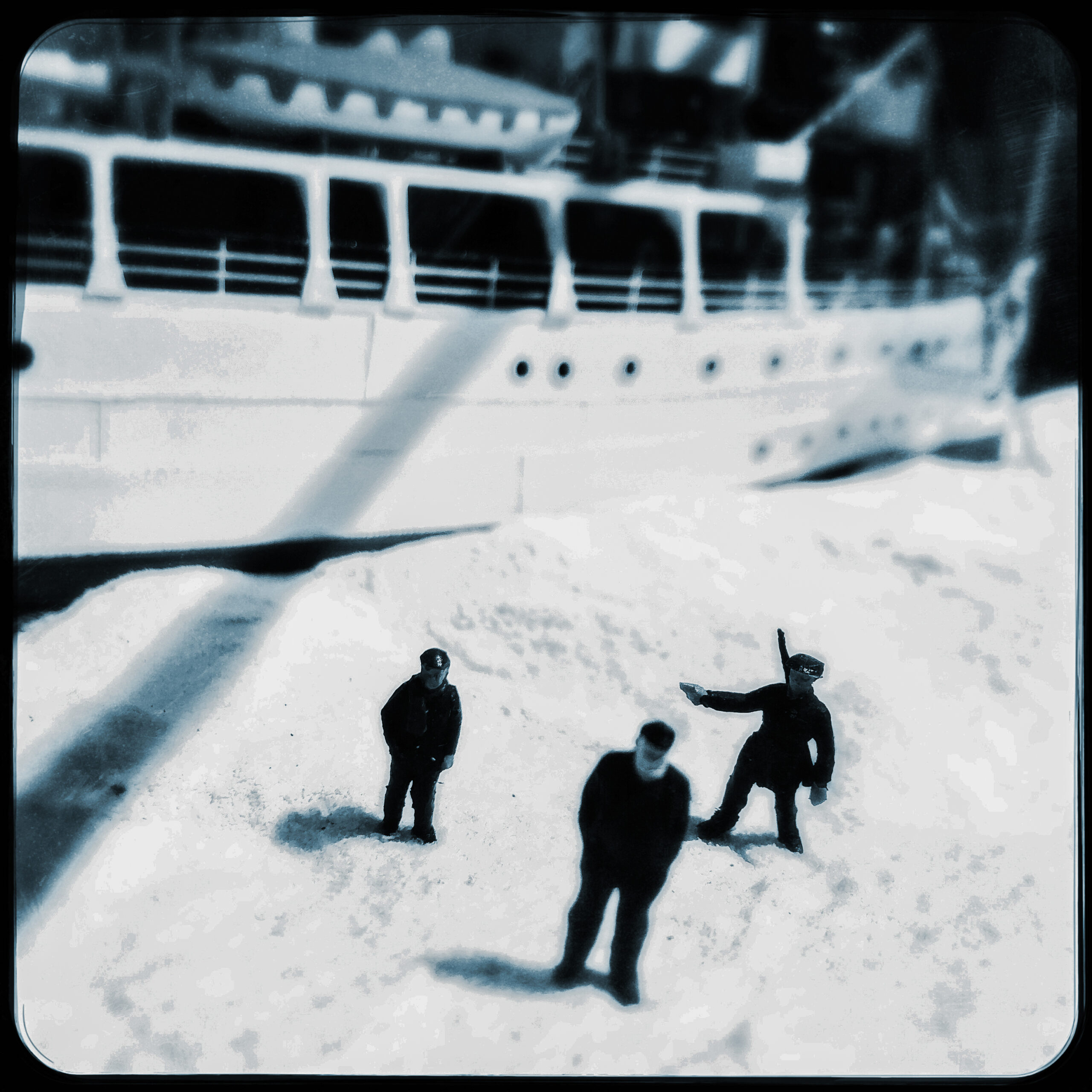
The iceberg, edges as sharp as an old sailor’s regret, glinted under half sun. Our ship, Endure, sat tethered to the ice mountain by sunken metal hooks and ropes thick as my wrists. Our ship’s engines had died weeks ago. From the prow I watched three men locked in a triangle of angst, a half dozen feet between each of them: our captain, Festus Crowe, his back turned toward the others, hands shoved sullen into his pockets as he stared into the white void beyond; Ship’s Mate Tommy Rourke fidgeted with a raccoon paw keychain he’d once told me was lucky; and ship Security Officer Harold Pine, who pointed a pistol toward Rourke’s chest.
Crowe’s black coattails flapped in the wind, tattered, as was his authority. He didn’t turn around. He’d seen enough in thirty years at sea—mutinies, storms, men broken by cold, boredom, love and demons.
“Speak, Pine,” he said, voice low, like he was talking to the ice. “What’s the allegation?”
“Rourke is stealing, sir. Rations. And I found laudanum in his footlocker, enough to deep sleep half the crew.”
“I ain’t touched nothing,” Rourke said calmly.
Captain Crowe’s boots crunched the ice as he shifted his weight. I knew he didn’t trust Pine any more than he trusted Rourke or anyone else on ship. So much had gone wrong in so little time. Pine was a company man, loyal to the ship’s owners, not to Captain Crowe or the sea. Rourke was a lifer, a deckhand who’d seen too many winters on ship and too few lovers on shore. The iceberg groaned.
“Laudanum,” said Crowe.
Pine’s jaw tightened. “The crew has been whispering about him for weeks.”
This, at least, was true.
Crowe said, “They whisper about mermaids and free sex in Vladivostok. You believe that, too?”
Pine reached into his coat, pulled out a half pint jar, the contents dark and syrupy.
Rourke, now excited or afraid, said “That ain’t mine! You planted it! Captain, I swear on my mother’s grave—”
“Your mother’s alive, Rourke.”
The iceberg creaked again, louder this time, a crack split the surface a few yards off. The ship rocked, the hull scraped against the ice. The ice mountain could split here at the edge, or the ship could break free, and then all three would be dead.
Crowe said, “Pine, you’re too quick with that firearm. It’s not always the answer.”
“I’m doing my job, sir. Protecting the ship’s assets. I am here to ensure order is sustained.”
“At sea, order has always been a myth. You got a story about how the drugs ended up in your footlocker, Rourke? Better make it good.”
“I caught Pine cheating at poker. He’s setting me up to cover his own crookery.”
“He’s desperate, sir.”
“We all are,” Crowe said as he rubbed his jaw and his white beard rasped under his leather glove. The wind howled, picking up flecks of ice that stung like shrapnel. Crowe had seen men like Pine before—shoot first types. Rourke was no altar boy, but a thief?
“Holster your weapon, Pine,” Crowe said.
Pine hesitated, then did as ordered. Rourke exhaled, his knees buckling slightly.
“I don’t believe either of you,” Crowe snapped. “We’ll be underway when my expeditionary crew returns with engine parts and fresh men. We’ll deal with this back at Bristol.”
The expeditionary crew would not return. We all knew they were dead by now.
The iceberg shuddered, a deep crack split the surface, wide as a shoe, closer now, spiderwebbing toward the three of them. The ship hull strained against the ice, an ancient, animal shriek. Captain Rourke rushed toward the ropes, checking the knots, his hands shaking. Chunks of ice caved into the water.
Crowe approached Pine. “Give me your weapon.”
“Captain, you know I can’t do that.”
Crowe ripped the pistol from Pine’s holster and turned toward the ship.
“Endure,” he said, as he raised the pistol to his temple and fired a round. His body collapsed.
Captain Crowe’s corpse looked like a stain of engine grease smeared across this tragic canvas of ice.
Anthony Swofford is the author of the memoirs Jarhead and Hotels, Hospitals, and Jails and the novel Exit A. His essays, reportage, and opinion pieces have appeared in Harper’s, The Guardian, Slate, and the New York Times, among other places. He is currently Special Faculty in the Department of English at Carnegie Mellon University where he teaches screenwriting, television writing and fiction. His current book project is a campus novel, Eight Great Atheists.