By Timothy R. Grieve-Carlson
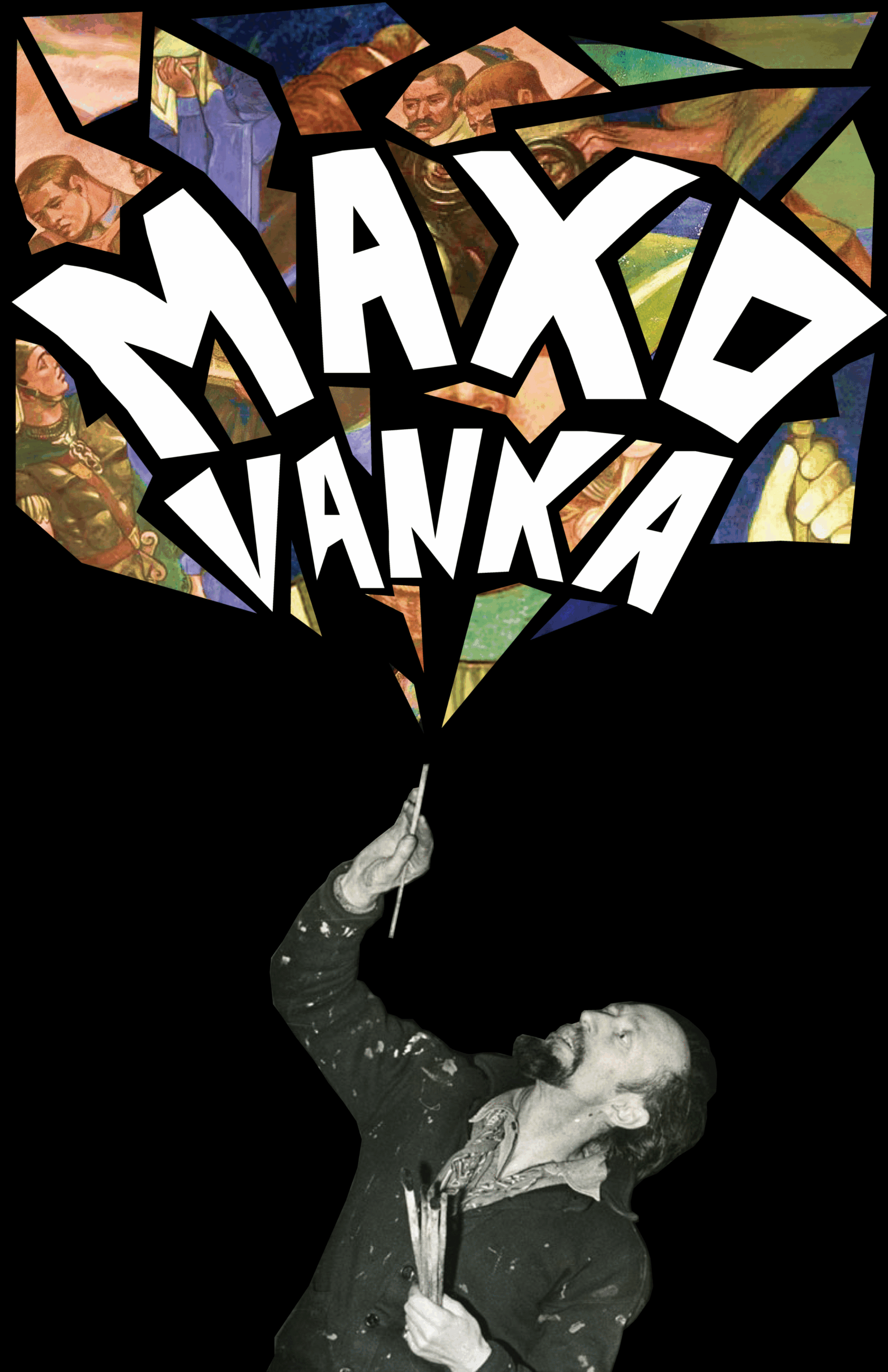
“Ihave a question,” said the gentleman who approached me after I gave a tour at the Millvale Murals of Maxo Vanka in June of 2025. He had just listened to me patiently and intently for over an hour as I did my best to interpret and contextualize some of the most striking, unique and beautiful mural art in the United States, all of which stands in an otherwise nondescript Catholic church that from its perch in Millvale, Pennsylvania overlooks the Allegheny River across from Pittsburgh.
“Is there a political position in these murals?” he asked, “and if so, what did the congregation think about it?”
The murals we were discussing included pieces like The Capitalist, a nightmarish portrait of a well-dressed man sitting alone before an untouched banquet, smirking through a cloud of cigarette smoke at a beggar crouched at the foot of his table. An angel in the background recoils from the scene in horror. Other murals include pieces like The Immigrant Mother Raises her Son for Industry, a heartbreaking scene depicting a crowd of women frantically mourning over the body of a young man apparently killed on the site of his industrial job, his tools laid out beside him, his own body placed onto newspaper as an impromptu bed, a human being transfigured into another piece of workplace detritus. Finally, in a pair of murals on the ceiling below the choir loft, Vanka portrays the Blessed Virgin Mary and the crucified Christ on a European battlefield, Christ’s side pierced with a soldier’s bayonet as Mary breaks the barrel of a soldier’s rifle in her hand, each of them condemning warfare as an ultimate act of human moral failure.
The murals repeatedly and relentlessly emphasize the spiritual significance of ordinary people, or immigrants, workers, and the impoverished. Vanka’s murals analogized the sacrifice of young men who die in war and on the job site with the sacrifice of Jesus on the Cross. The women who mourn young soldiers and workers are dressed in the same clothing as Mary in Vanka’s depiction of a Pietà; the mothers of soldiers and steelworkers recover the bodies of their sons and share in the Virgin’s agony. Vanka’s murals at St. Nicholas force the viewer to see the worker, the soldier, and the women who mourned them (he worked in two phases, in 1937 and 1941, when the social spheres of men and women remained largely separate) as spiritual heroes who valiantly persisted through the moral catastrophes of capitalist greed and global war.
There is a politics in these murals, beautifully and forcefully expressed. But I hear this surprising question all the time during public tours of Vanka’s murals – what political statement is being made here? How did the congregation and community react?
The interesting question for me, in 2025, is how exactly the politics of these murals have become largely illegible to an American public in the years that have passed since their composition. Why do so many Americans find clear expressions of class-solidarity – of anti-capitalist, anti-war, and pro-worker sentiments – from the twentieth century essentially beyond the pale of political discourse?
The artist, Maxo Vanka (1889-1963), was the illegitimate child of Austro-Hungarian nobility in Zagreb (modern-day Croatia) who was immediately given over to his peasant wet-nurse to raise him as her own son. At the age of eight, his maternal grandfather learned of his existence and arranged for him to receive a private education at some of the best schools in Zagreb. Vanka had a hybrid class background, plucked from a peasant childhood into the advantages (if not the titles and recognition) of nobility. He became a professional fine artist, working in eastern Europe throughout the early twentieth-century, deployed to the front lines of World War I as a member of the Belgian Red Cross and eventually leaving Europe for the United States with his wife and daughter in the 1930s.
Vanka arrived in the United States at the height of the Great Depression. From his home base in Manhattan, Vanka made several trips into the Northeast and Midwest with his friend, the Slovenian-American author Louis Adamic. During these trips, Vanka made sketches of Americans and American landscapes that did not make it onto postcards: “He seemed inevitably to gravitate toward the lowly, dirty, degenerate and neglected,” Adamic wrote of his friend. Poor people, industrial landscapes, and workers were Vanka’s subjects in the new world.
In 1937, Louis Adamic received a letter from Father Albert Zagar, Pastor of the Croatian Catholic Church of St. Nicholas in Millvale, Pennsylvania. Zagar had seen an exhibition of Vanka’s work in Pittsburgh in 1934, and he was struck by the talent and social conscience of this Croatian artist—“One of our own people!” he wrote—living and working in New York City. Adamic connected the two, and Zagar impressed Vanka with his character as “a true follower of Saint Francis of Assisi” and his willingness to allow the artist total creative freedom. Vanka got to work on murals like The Immigrant Mother Raises her Son for Industry in 1937, returning in 1941 to complete the walls of the church with pieces like The Capitalist.
Vanka did not leave a written statement on the politics of his murals—he trusted his audience, the congregation at Saint Nicholas, to interpret and understand his work considering their own experience as immigrant workers in the United States. His own political perspective was shaped decidedly by a form of Christian socialism that was common in these communities, in which capital and greed were widely understood as forces of profound moral and social evil that could only be held back by solidarity of working-class people.
Vanka’s politics of trade union socialism were shared with his friend and intellectual interlocuter Louis Adamic, as well as the community of immigrant workers in Millvale. Vanka’s intellectual and political connection with Adamic is evident on the murals themselves: Vanka’s mural Mati, which memorializes the 1941 Axis invasion of Croatia (then a part of Yugoslavia) includes Vanka’s dedication to Louis Adamic on an open book at the figure’s feet. A closer look at Adamic’s writing on politics gives us some indirect insight into the political perspective that shaped Vanka’s murals.
Adamic’s 1931 book Dynamite: A History of Class Violence in America is a bracing depiction of an American labor movement bearing the brunt of violence not of their own making but brought on as they resisted the power of American capitalism. Adamic never adopted a specific political party or label: “I am not, and never was, a member of any labor union or political party or movement in the United States,” he wrote, in a statement that sounds much more like a criminal defense than an honest statement of his own politics (I’m going to try this one next Thanksgiving). But the story he tells in Dynamite is one of unambiguous sympathy and solidarity with American workers, and a “most severe criticism,” as he calls it, of American capitalism. Striking workers, crowds of the unemployed and hungry, and protesters were repeatedly brutalized by state and corporate power in the decades leading up to Adamic’s writing in 1931. “I realize that,” he wrote at the end of the book, “I have put together a rather dreadful story.”
A dreadful story, but not always a pessimistic one. Like many left and labor activists at the time, Adamic believed that social democracy was inevitable, even in a country like the United States, where capital seemed willing and able to deploy limitless resources against the populace: “Society must always compel business to function for the social good, and not only for the social good but for the good of business itself,” Adamic wrote. Capital and business itself were suicidally short-sighted without constant regulation: “Business would have ruined itself and the country long ago, were it not for occasional spurts of social action to curb it.”
Adamic, like Marx, saw socialism as the inevitable outcome of rampant capitalism, which was itself a necessary stage of social development that propelled Europe out of feudalism and into modernity. Social progress and social good were only possible if business and capital were proactively channeled toward them: acting without guardrails, the blind idiot force of the market would march the whole world off a cliff with it.
Adamic was candid on the sorry state of the American labor movement in the 1930s. “American labor,” he wrote, “is still bewildered, deeply distraught by the suffering and humiliation of the past several years, unconsciously ashamed of its own ineffectiveness, frightfully unclear as to what it thinks it wants or ought to want.” Adamic was writing just a few years before Maxo Vanka would paint The Immigrant Mother Raises her Son for Industry, showing the sprawling body of a dead worker on newspaper that read in Croatian, “The immigrant mothers have sacrificed their children for building American industry.”
American politics was at a crossroads at the time of Adamic’s writing and Vanka’s painting, and both men seemed to sense the enormous social potential of American society along with the possibility that this potential would be crushed by capital’s tightening grip.
Adamic was found dead with a gunshot wound to the head in his home in Riegelsville, New Jersey, in 1951. Someone had set fire to his farmhouse with oily rags in several places, and an article with the headline “Adamic Red Spy, Woman Charges” was found on his body. He had been called up previously by the House Un-American Activities Committee, and despite his earlier claim that he was never a member of any political party in the United States, he was widely considered a communist. Local police ruled the event a suicide, while the FBI refused to investigate. Several people who spoke with Adamic shortly before his said he mentioned that he said he was paid “a visit to the farm by four strangers who, somewhat threateningly, inquired into the direction the book [Adamic was writing at the time] was following.” By 1951, Adamic was a leading voice of the American anti-Soviet left, having broken with Stalin along with the Communist Party of Yugoslavia as so many other radical Slovenes in the United States also had. At the time, there was suspicion that Adamic had been killed by Soviet agents or sympathizers. Following the recent revelations of the extent of violent American anticommunist activity in books like Vincent Bevin’s The Jakarta Method: Washington’s Anticommunist Crusade and the Mass Murder Program that Shaped Our World (2020), it’s not hard to imagine that there may have been a more home-grown culprit in the violent death of one of the great American authors of the early twentieth century.
Writing in 1934, in a revised edition of Dynamite, Adamic considered the United States to be country of tremendous social potential that was likely to be squandered in the short term: “America is at the crossroads. She can’t stay where she is, not for long. Right or left? Probably right first, then left. But eventually it will be left: for, in its very nature (which I can’t discuss here) it is a left or revolutionary country.” Reading this passage ninety-one years after Adamic’s writing, it is hard to agree with his sentiment that the United States, “in its very nature” is a left country—never mind a revolutionary one.
The murals at of Croatian Catholic Church of St. Nicholas in Millvale do indeed have an implicit politics that was intimately familiar to the congregation, but it is the politics of an American and international left that is so distant from us now that it is often illegible to many Americans who tour these murals regularly. Most Americans today do not have even have a political sense of themselves as workers, never mind class consciousness. The ruined factory-sites of many of the labor uprisings that Adamic described in Dynamite are now deep MAGA territory. Immigration to the United States is violently tightening again as it did in the early twentieth-century, and figures just like The Capitalist are more powerful than they ever were when Vanka painted them in 1941.
Places like Millvale are haunted by the ghosts of Christian socialism and the old American left in the artifacts of people Vanka and Adamic, hints of a time before America turned decisively and hurtled right at the crossroads. Our dim memory of the Christian socialism expressed on the walls of Saint Nick’s is also a reminder of how quickly and decisively the tides of politics and social will can change—for ill or for good. As dim as our memory of the old American left, of popular class-solidarity is, it is a recent memory. And the tides can turn quickly.
Timothy R. Grieve-Carlson is Assistant Professor of Religion in the Department of Religion and Philosophy at Westminster College.
![“Art is [still] a Weapon”: A Brief History of the Protest Novel](https://beltmag.com/wp-content/uploads/2025/11/G20-protests-turn-violent-in-Pittsburgh-500x383.webp)