“Abernathy may be outnumbered, but he is not alone. This is a picture of two people trusting one another to hold the agents of power to account, to document their violence.”
by Kristen Hall-Geisler
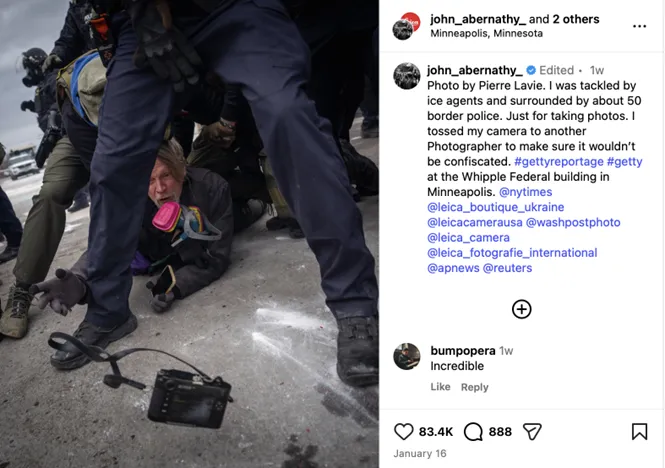
When you have a hammer, the saying goes, everything looks like a nail. When you have a master’s degree in English literature and language, everything looks like a close reading. When an image of a man saving his documentary photographic work while being tackled by the agents he was documenting lodged in my brain, I applied the framework I know best to parse what I was thinking.
The photo was posted to John Abernathy’s Instagram account on January 17, 2026, and it is credited to Pierre Lavie. I think it’s fair to consider Abernathy’s caption alongside the image, as they were presented together.
The subject of the photo is the face of a man, just to the left of the center of the frame and seen between the legs of someone in dark blue pants and tactical boots. He appears to be white and middle aged, with light-colored hair draping over his temple and covering his ear. A gray goatee surrounds his slightly open mouth. It’s challenging to read his expression, but he doesn’t seem to be afraid. His concentration seems to be entirely on his camera as he tosses it away. According to the Instagram text, this is a photo of Abernathy. Below his chin hangs the bright pink plastic covers of the filter cartridges on a gas mask. One forearm rests on the dry gray pavement, and his gloved hand holds his phone. The tips of the thumb and forefinger of his glove are black, while the rest is gray, probably because they are capacitive; he can use his smartphone without taking off his gloves. His tagging Getty in his caption suggests he supplies editorial photos to this international image service. He is dressed for the weather and for the job. His gas mask shows that he either has been in similar situations where chemical weapons were used before or he has done the research to learn that they are likely to be used here.
Abernathy’s other hand is extended, his inner wrist grazing the leg of the person in blue pants. His fingers are spread as if they have just released the camera that is in the foreground of the frame. This is further evidence of his experience as a news photographer. He is aware that even if, or maybe when, he goes down, he has to find a way to preserve the images that he has taken.
The camera is sailing through the air a few inches above the pavement. Its strap trails behind, leading back toward the hand that has just flung it away. The dark screen at the back of the camera is toward the viewer. An argument could be easily made that that camera, and the images on it that Abernathy is trying to preserve, are the actual subject of the photo. It is closest to the photographer, Lavie, and to the viewer.
Though Lavie is out of the frame, he is present in the image. It is to him that Abernathy is tossing the camera. Lavie has the professionalism, or at least the presence of mind, to take this shot before reaching for the camera and before the people subduing Abernathy turn their full attention to him. He has the knowledge and the practice to frame this image for maximum impact and action, even if he did use a burst feature to take several images within a short span of time and then choose the best image later. That choice, too, is an exhibition of skill and craft.
The blue-clad legs in the photo have taken a wide stance, and this person is facing Lavie. Gloves dangle from the person’s belt, and there is a red canister in a holster at their hip. Between the black tactical boots are small white bursts on the pavement. These are evidence of less-lethal weaponry being recently used, likely pepper balls, justifying the gas mask around Abernathy’s neck.
Also framed between these legs, we can see a knee pressing into Abernathy’s back. Yet another person, clad in greenish-gray, is at the left edge of the frame and bending over him. Above the back of this third person is another person’s arm, in a black jacket with a gray glove. This brings the count of people actively subduing Abernathy to four, and no two of them are dressed uniformly, let alone in the same color. Abernathy’s caption says that these were Immigration and Customs Enforcement agents, but we see no identification. The viewer of this image would have to turn to an outside resource, such as the one published by the New York Times in October, to identify which agents these might be based on clothing alone.
In the background to the left is another person in black with a helmet and gas mask; they are a few yards away and facing another direction. There’s also a black-clad leg belonging to someone walking away at the edge of the photo. At the right edge of the frame is a jumble of black clothing and boots; it’s difficult to tell if these people are directly involved in subduing the photographer. The viewer is unable to see identification for these agents as well.
It is notable that the subject of the photo is a bare face, gas mask pulled down, while the faces of the people surrounding him and holding him to the ground are not visible. It makes the viewer ask: How do the people in this photo want to be seen, or not seen? Abernathy wants to be seen as a professional photographer documenting events despite the dangers. He is prepared for the assignment, and he will protect his images for publication in some form. The people subduing him want to be seen as militaristic but not uniform, powerful but anonymous. They are prepared for physical confrontation, and they will create opportunities for it.
Behind all of this is a bank of steel-gray clouds.
The Bartesian Myth
If close reading is my hammer, Roland Barthes’s conception of myth is my preferred lens, to shift to a new metaphorical tool. Barthes posits that myth is a second-order level of meaning conferred by those in power to create a shared idea that upholds their power. Language is built on the signifier and the signified, which together create the sign that carries first-order meaning. When that sign becomes a new signifier, alongside a new signified, the result isn’t a new concrete sign, like a photograph or a word; it’s a myth.
Looking at the signifiers in the photo, Abernathy appears to be a middle-aged white man. He has equipment appropriate for his work, more expensive and specialized than the average person would use. It is, as they say, professional grade, and yet he’s throwing it away. He’s wearing a gas mask. The other signifiers are the military-like pants and boots on the people surrounding him and holding him on the ground.
That leads the viewer to the signified: Abernathy is a photographer, and he is being restrained by sanctioned force. And thus to the sign, the language that we “read” in the photo: In the course of covering a protest, this photographer was taken down by unidentified agents, probably federal immigration agents, so he tossed his camera to safety to keep it away from those agents.
This sign, in Barthes’s formulation, becomes the new signifier for the myth. It builds on what we read in the photo. The new signified in this second-order system becomes official strength through physical subjugation.
Thus the myth that upholds what the powerful need everyone, on both sides, to believe in order to maintain their power: Even if you are a middle-aged professional white man working under the auspices of the very First Amendment in the United States Constitution, which guarantees both the freedom of the press and the right to peaceably assemble, you are not safe. We are that powerful. We are unstoppable. We are not fifty agents; we are innumerable.
But myths can be pierced, and Lavie is the one piercing it. Abernathy tosses him the camera, and Lavie takes the picture. They may not be working together on this day. They may not even really know each other. The viewer cannot tell based on this snapshot of a moment. But what the viewer can see is that Abernathy trusts Lavie, a fellow photographer, to grab his camera and keep it out of the hands of the people holding him down. And he might even hope that Lavie has the presence of mind and the professional reflexes to take a photo of what is happening to him. Lavie does. Abernathy may be outnumbered, but he is not alone. This is a picture of two people trusting one another to hold the agents of power to account, to document their violence. That trust is the shiny little pin that punctures the balloon of this myth.