By T.N. Eyer
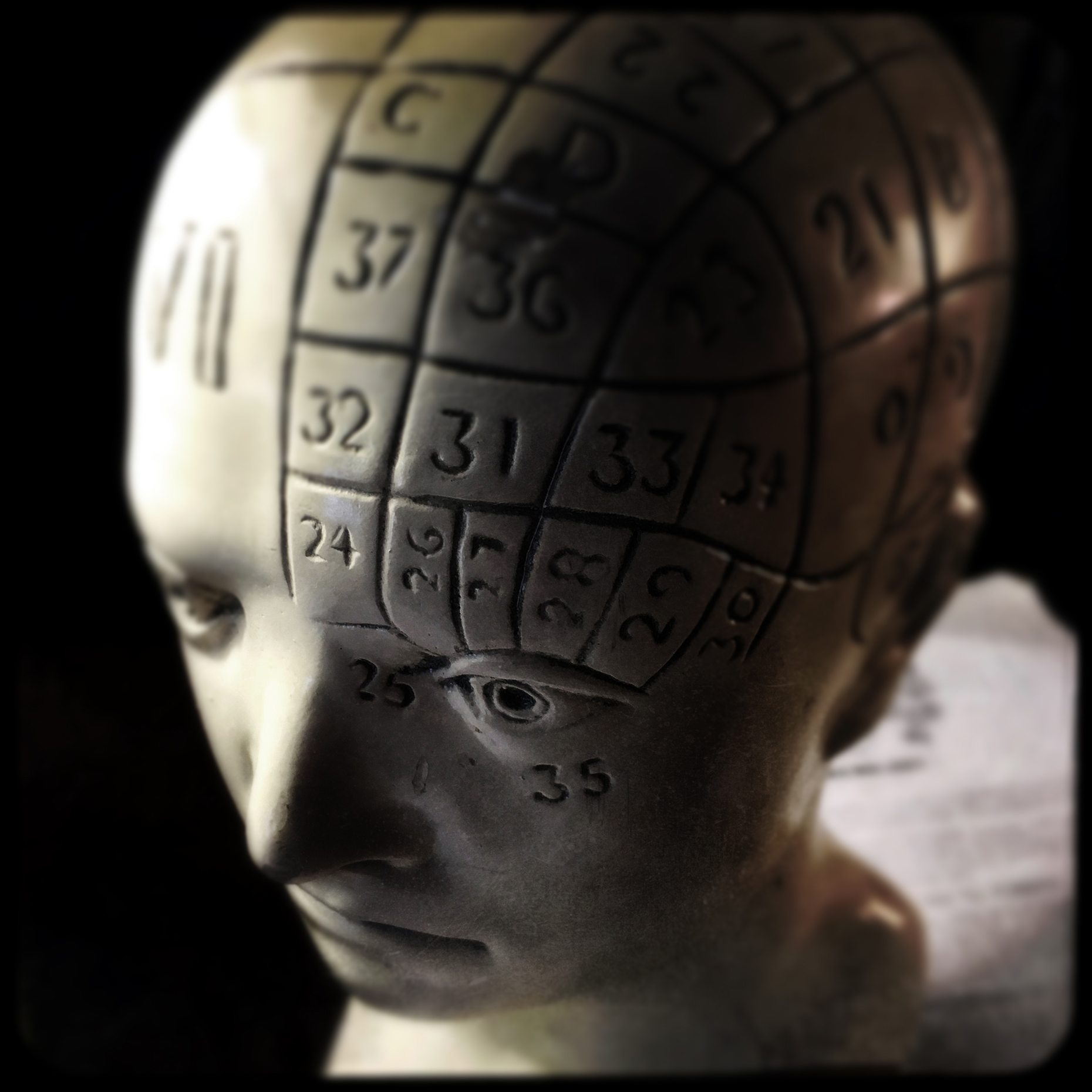
We find the bust unboxed in the attic. Dust-covered and laden with spider webs, it probably hasn’t been touched by human hands in decades.
“What is it?” my sister Rebecca asks.
“It’s a phrenology bust,” I reply, tracing my fingers along its lines and numbers. Although it is drafty in the attic, the bust is strangely warm, as though it is being heated from within. When I pull my hand away, my fingers are tingling and covered in dust.
“Phrenology,” Rebecca repeats, slowly, as though she’s searching her memory for the meaning of the word.
Our eyes meet. “Bernard,” we say simultaneously.
Bernard, our most famous ancestor, was a notorious New World practitioner of phrenology. He wrote articles about its merit and gave public demonstrations. The rich would summon him to their mansions, where they would pay exorbitant fees to have the skulls of their children assessed. In this way, he amassed a small fortune.
But then something peculiar happened – a series of accusations that Bernard was not using phrenology just to learn about his clients but to influence them, that he was physically reshaping the portions of their brain responsible for loyalty, generosity, credulity.
The claims were preposterous, of course. Bernard was not a surgeon, and brains are not clay. But people believed all sorts of things in the early nineteenth century, and, ultimately, a frightened mob burned Bernard’s house to the ground with him in it.
“How does it work?” my sister asks, eyeing the bust warily.
“Phrenologists believed each portion of the brain was responsible for a different personality trait. The size of the brain in that region indicated the strength of that trait.”
I point at the number thirty-seven, located in the front center of the bust. “This might correspond with your ability to concentrate. Or your cautiousness.”
“Weird,” my sister says, wrinkling her nose. “Let’s try it.”
I indulge her, sitting cross-legged on the wooden floor. She kneels behind me, and a moment later I feel her fingers kneading into my skull.
“There’s a small indent here, in the intelligence region,” she says, rubbing the crown of my head. “There’s no easy way to say this, but it appears you’re a bit of an idiot.”
I elbow her in the stomach, but I’m laughing.
“My turn,” I say, as we trade places.
She is chuckling as I move my fingers into her curly hair, begin to feel along the contours of her skull. I press a little harder, and my fingertips sink into my sister’s head as though it is putty.
“Oh shit,” I cry, pulling my fingers out.
“What?” she asks, looking at me. “What is it?”
But I don’t know. I don’t have the words.
“Keep going,” she urges, impatient.
I nod, convinced I must have been mistaken. A skull is bone, I remind myself. Bones are firm, solid, unyielding. I am more cautious this time. I move my thumbs gently along my sister’s hairline. To my relief, everything stays in place, and I begin to breathe more easily.
I push a little more firmly. As I do, I feel Rebecca’s skull, moving with my thumbs, changing shape beneath them. As this happens, I feel my confidence in my sanity shift, too. Logically, I know this can’t be happening. I can’t reshape a skull. I must be hallucinating.
Suddenly, my sister snaps, “Can’t come up with anything can you? No, of course not. You’ve never had a creative bone in your body.”
I recoil. Rebecca has never spoken to me so harshly before.
Frightened now, I plunge my fingers into her skull again, push it around like pizza dough. My heart beats rapidly, and my head is beginning to ache. Best case scenario my sister is messing with me, but I am deeply afraid that I have meddled with something I don’t understand.
Rebecca cries out. “Something is wrong. Something is very, very wrong. You’ve got to fix it. Please.”
Panic takes the form of bile, rising in my throat. I swallow it back, debating what to do next. I feel like I’m in one of those time travel movies, the “butterfly effect” ones, where they warn the protagonist not to change anything in the past or it will affect the future. I have changed my sister’s brain, altered her permanently, and now there is no going back. The best I can do is attempt to find some approximation of the person she was.
I nudge and tug, rub and coax. I am perspiring, even though it’s chilly up here.
Rebecca begins rambling, a string of increasingly incoherent sentences. “It isn’t the dishwasher. Maybe the blender. Or the birds. It could be the birds. They’re not real. They’ve never been real. A soundtrack. Chirp chirp. Buzz buzz.”
I try to block her out, to focus on the task at hand, but my vision has blurred, and I’m trembling so badly I’m afraid I’ll scramble anything I touch. I pull my hands away once more.
I remember Bernard, the rumors about him manipulating his clients’ skulls. Could this have been what they meant? Could he do this, too? Can anyone?
No, I realize. Rebecca hadn’t exactly been gentle with my skull a few minutes ago, and it hadn’t moved or changed. So, either she has an unusually malleable head, or I have a freaky, inhuman ability.
“Why have you stopped?” Rebecca groans. “You haven’t fixed me yet.”
“Okay,” I say. “Okay, I know.” I close my eyes, take several deep breaths and try again. But it is too soon, and I am too unsteady. I shift a chunk of skull bone abruptly, and Rebecca falls silent. I step back, wrap my arms around my shoulders.
“Becks?” I whisper.
When she doesn’t respond, I squat down in front of her. She is looking at the floor, and timidly, I lift her chin, touching her as I might an unfamiliar pet.
Her eyes are vacant, and her mouth is open. Drool dribbles down her chin.
I burst into tears. What have I done?
Blurry-eyed and dizzy, I rush over to the bust, search it for some kind of ledger, desperate to learn what the numbers mean, which traits they’re responsible for. Nothing. With effort, I lift the bust and then nearly drop it as my fingers instantly warm against it, startling me.
More careful now, I turn the bust over, but there’s nothing helpful there, just a one-line inscription: Property of Bernard Bauer.
I set the bust back on the floor and turn to the internet, googling furiously in search of guidance. But I quickly learn that there had been no consistency among phrenologists, who couldn’t even agree on how many regions of the brain there were, let alone what they signified.
I close my eyes, curl my hands into fists, and scream.
I know I have to try again, to keep trying. But even as I begin manipulating my sister’s skull once more, I have the sickening sense that everything I attempt is futile.
Rebecca falls forward to the hardwood floor with a thud. I flip her body over. She is alive but unresponsive. Comatose maybe.
I stare at her, horrified. My heart is pounding, and my migraine roars. I press my palms to my temples, move my fingers to my scalp, and begin to massage my head in a desperate attempt to alleviate the pain.
I only realize my mistake when I feel my skull shifting beneath my hands. I gasp and try to pry them away, but I no longer control my limbs.
I inadvertently shift my fingers, feel my skull move again. My body becomes rigid and collapses atop my sister’s. I am immobile, petrified.
I try to devise a plan, but it’s useless. Without the ability to move, I can’t execute any of my ideas. I can’t even close my eyes. All I can do is stare, unblinking, at the eerie porcelain bust resting beside me on the attic floor.
T.N. Eyer graduated from Yale College and Yale Law School. She practiced corporate law in London and in Los Angeles before happily transitioning to writing fiction full time. Her first novel, Finding Meaning in the Age of Immortality, was published by Stillhouse Press in November 2023. Her short fiction has appeared in december magazine, Hayden’s Ferry Review, and Water~Stone Review, among others. Her story “Date of Death” was listed as a Distinguished Story in Best American Short Stories 2022, and her story “The Offer” won third place in the Bridport Prize Short Story Competition. She is an alumna of the Bread Loaf, Community of Writers in Olympic Valley, and Futurescapes writers’ workshops. She is an avid reader, hiker, and traveler. She has gone caving in Vietnam, horseback riding in Mongolia, and sand sledding in Namibia, but when she’s home she gets most of her exercise playing Dance Dance Revolution in her garage. She lives in Pittsburgh, Pennsylvania with her husband and daughter.