By Wendy Arons
“Power tends to corrupt, and absolute power corrupts absolutely.” This truism – originally penned by Lord Acton in the late nineteenth century – is a primary object of investigation in Turkish/French playwright Sedef Ecer’s cynical play First Lady.
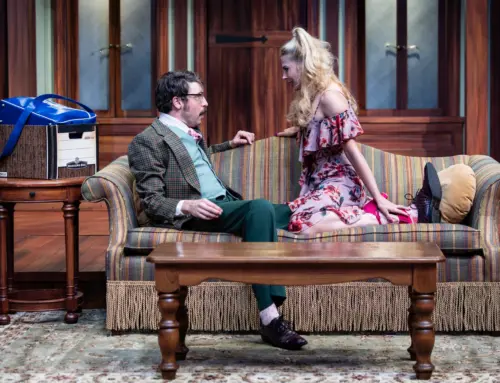
The play is set in a “modern banana republic” in a vaguely defined Mesopotamia, in the midst of a popular uprising against an oppressive authoritarian president. The president – whom we never see – has secretly fled the country; his ministers, in a desperate attempt to quell the nascent overthrow of the government, arrange for his first lady, Ishtar (Elizabeth Elias Huffman) to do a live “human interest” television interview that they hope will convince the populace that there isn’t a revolution brewing, the idea being that concealing an uprising is the best way to prevent its spread. In order to pull this off, they keep Ishtar in the dark about the rioting in the streets, and also arrange for a relatively inexperienced journalist, Yasmine (Milia Ayache), to conduct the interview, in a television studio located within the president’s summer palace. Managing this whole situation within the palace are Ishtar’s chief of staff and “scorpion” Elish (Doren Elias), a figure simultaneously obsequious and menacing, and her stylist, Gazal (Treasure Treasure), who serves as makeup artist, wardrobe specialist, and emotional support for the needy first lady. But the plan doesn’t work; midway through the interview they are interrupted with news that the riots are spreading and intensifying, and Ishtar, Elish, and Gazal must cope with the fact that they’ve been left to their own devices, the president and all his ministers having opted to save their own skins.
In the first act, both play and production start out strong as a satirical and cynical dissection of how those in power work to keep themselves there. But in the second act First Lady loses focus, both in terms of its storytelling and its tone. The jaundiced portrait of corrupted leadership in act one gives way, for large stretches of the second act, to a farcical scramble among the characters to figure out how to flee the palace before the mob arrives, and a back story that links Yasmine to Ishtar – and that gets unspooled at a climactic moment – jarringly pulls the play into a melodramatic register that doesn’t feel fully earned. Moreover, Ecer pulls in so many interrelated ideas – for example, that people who scrabble from poverty into power often betray or look down upon the impoverished, that revolutions eat their young, that history is doomed to repeat itself, that metaphorical rats (in this case, craven ministers) will always abandon a sinking ship, and that the regime ushered in by a revolution is often worse than what it replaces – that it starts to feel like the play is trying to juggle more idea-balls than it can handle, and ends up dropping most of them in the process.
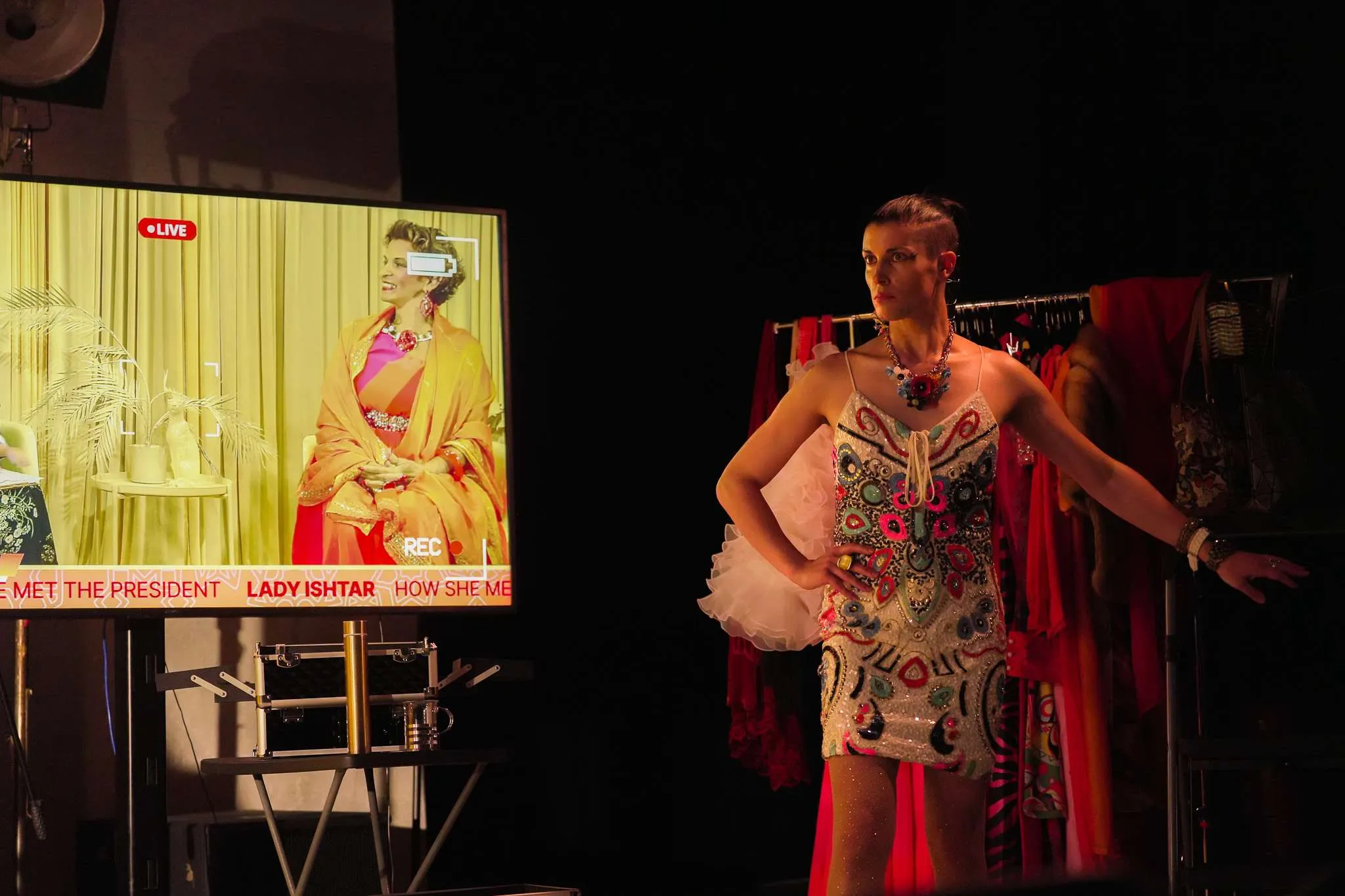
Nonetheless, the PICT production at Carnegie Stage – directed by Adil Mansoor with stylish flair – offers solid performances by all four ensemble members and an inventive and technically ambitious design chock full of visual humor. Sasha Jin Schwartz’s in-palace TV studio achieves the combination of lavish and tacky that characterizes spaces beloved by people with a lot of money and not much taste: for example, the interview takes place in front of voluminous yellow drapery that aims to signal luxury on the TV screen but also seems to be made of a cheap synthetic material. The characters’ clothing likewise ludicrously displays their opulence – Ishtar wears an almost unbearable combination of orange and pink while Gazal is incongruously clad in a gaudily beaded minidress – their expensive and impractical couture sending a clear message about how truly out of touch Ishtar is from the concerns of the populace (costumes by E. E. Huffman). Scott Andrew’s media design is cheeky and sly, using video in myriad ways to demonstrate the ineptitude and hollowness of the oppressive regime. His clever conceit seems to be that in this fictional scenario, in which the powers-that-be set out to control the image at all costs, no one seems to know how to properly operate a camera – all of the images we see are fragmented, impartial, obscured, effaced, or frozen.
One of the funniest examples of this comes during the early part of Yasmine’s interview with Ishtar, when Elish frames the shot such that the media logo fully obliterates Yasmine’s face, thereby erasing the representative of the people from the broadcast. It’s in moments like this that the play’s satire and cynicism most effectively captures how dictatorships operate. Depressingly, such a depiction feels all too timely.