By Adrianna Michell
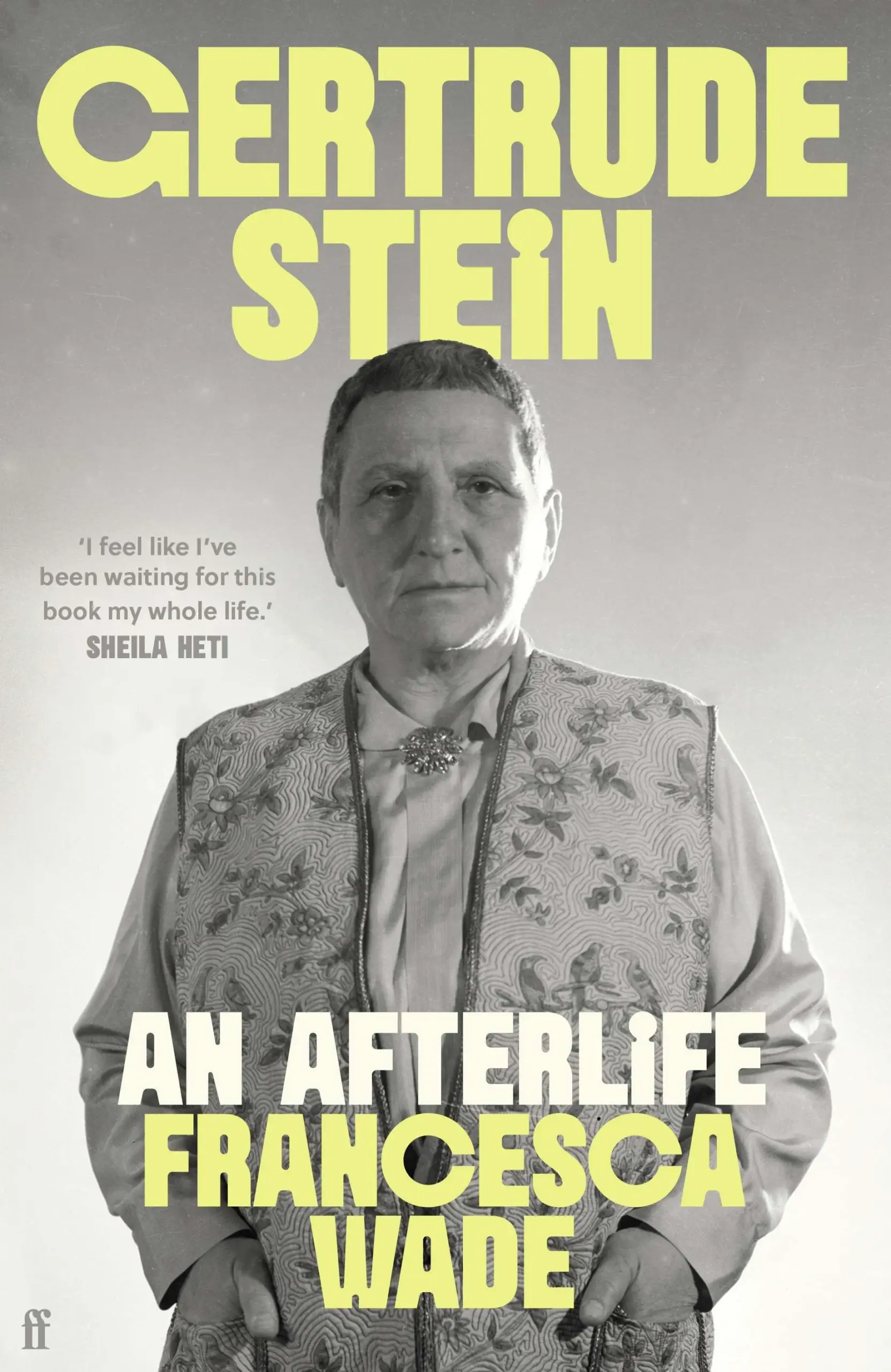
In Janet Malcolm’s Two Lives, a literary biography of Gertrude Stein and her partner Alice Toklas, there emerges a third character: that of the biographer. This is Malcom herself, but there is also the milieu of biographers, or the biographical impulse writ large, which seem to find in Stein inexhaustible subject matter. In one scene, Malcom recounts meeting with three other Stein biographers—including Ulla E. Dydo, author of A Stein Reader—effectively supplanting Stein’s position as the biographical subject. As Malcolm explains, Dydo’s archival research forever changes how we read, for instance, Stein’s Stanzas in Meditation: she speculates that Toklas slashed out every “may” and replaced it with the imprecise “can” to remove any possible reference to Stein’s former lover May Bookstaver. This embedded story reveals Toklas’s petulant editorship, Stein’s devotion to her lover (even at the expense of syntactic coherence), and is the focus of Francesca Wade’s newly released Gertrude Stein: An Afterlife, the biographer’s central role in Stein’s literary legacy.
As suggested by the subtitle An Afterlife, Wade extends the biographer’s purview to the posthumous, focusing on Stein’s critical re-appraisal in the years following her death. Wade makes characters of the literary critics and archivists often hidden behind the notebooks and cardboard boxes, unseen by the reading public. Though the first half of An Afterlife retraces Stein’s life and work according to biographical convention, the second half narrates her legacy as a product of deliberate and painstaking construction. Stein was explicit in her desire for artistic immortality—“I am working for what will endure, not for a public”—but she was less explicit in exactly how her legacy should be constructed and to what degree it should be mediated. Wade details several archival squabbles to this effect, including whether some materials should be in the Yale collection at all, as is the case with the around sixty notes addressed from Stein to her ‘“darling wife,” “birdie,” “boss,” which vary in degree of sexually explicit content but are almost entirely intimate.
It’s not uncommon for an author to leave an expansive archive. Nor is it particularly remarkable that Stein’s work has drawn in several would-be biographers. Yet there is something distinct about the way in which Stein haunts American literary celebrity, especially as she has become a kind of biographical cipher, a subject onto which biographers seem keen to project the issue of biographical writing itself. Why is it, then, that these stewards of Steinian ephemera—her literary executor Carl Can Vechten and doctoral student turned Toklas confidant Leon Katz, to name a few—endure as the third collective life of Stein’s “three lives?” Is it because Stein’s work is just too hard (Malcolm: “Of all writers she may be the one whose work most cries out for the assistance of biography in its interpretation”)? Or the historical significance of her artists’ salon in France? Or is it something about the author herself: her beguiling personality, the contradiction between her sexual identity and reactionary politics? Wade’s new biography offers an answer: Stein endures as a biographical subject not just because of her celebrity but because of the autobiographical nature of her writing. For Wade, there is no separation between Stein and her art, since her concerns are “the process of shaping everyday experience into language” and “the relationship between author, text and audience.” Wade makes the case that to address Stein’s art without life or, as was more common, her life without the art, does not just make for bad biography but elides her artistic achievements. Wade sums this up in Stein’s own words: “Facts of life make literature.”
An Afterlife revitalizes Steinian biography by participating in a broader shift in biographical writing. No longer the “great man” hagiography, but certainly not the Malcolm-esque journalistic narrative that focalizes the biographer at the expense of the subject. An Afterlife contributes to a development in biographical writing that aims for a more expansive, if less romantic narrative, which we might call a biography of literary systems, rather than of an enclosed literary subject.
In this way, Wade sets herself apart from Malcolm early on, if indirectly. Wade’s voice shrinks from editorializing whereas Malcolm (“caustic dissector of scholarly intrigues,” as described by Wade) insinuates herself into Stein’s story. Even after Stein’s death, when the other biographers—or the desire for biographical coherence itself—emerge as actants, Wade merely works among them, laying out the decades of archival research preceding the present book. Wade further distinguishes herself in that she, unlike Malcolm, seems to like Stein’s work. Malcolm describes reading the revelatory The Making of Americans as a chore akin to cleaning your windows: something you should probably do, but for the most part could go on without noticing the dirt. Wade corrects this characterization in her prologue; by page five she admits that she took some time to “take the plunge and open it” but soon was “hooked by its rhythms, eager to follow Stein’s restless sentences as they quest towards conclusion.” In doing so , Wade positions herself as the kind of biographer we should trust: a more attentive reader of Stein, one who won’t get caught up in personal grudges with a ghost.
But, to complete my comparison, which I think is necessary given Malcolm’s stature in biographical writing (though she is scant mentioned in An Afterlife), the consequence is that Two Lives dramatizes some of the questions Wade can only gesture to. While Wade writes that “Both Stein and Toklas knew the story a biographer can tell will always depend on the material made available to them” and thus will always “be partial and highly subjective,” Malcolm’s lack of access (chiefly to the interview transcripts with Toklas that Leon Katz secreted away, and which Wade was the first to see) recreates this for the reader. Even so, there is an honesty in An Afterlife’s modest distance. It knows that even though biography and detective fiction both “begin with a corpse,” the former need not prosecute a case, nor are there any clear culprits to be found.
—
Despite the contrast I’ve set up thus far I must insist that An Afterlife stands on its own. Wade recounts Stein’s writing life by digging into the texts themselves as much as she digs into the archive, thereby excavating the personal events that provoked such innovative linguistic experimentation. Take Wade’s description of Melanctha for an example: she writes that the “cascades of simple, repeated words and phrases, nuanced by slight variations which heighten the reader’s alertness to the rhythm of the text.” Further, Wade finds that “time moves forward almost imperceptibly – a stream of paragraphs beginning ‘always now’ locates the reader, and characters, in a shared present – as the characters’ feelings slowly change: they keep ‘feeling’, ‘talking’, ‘suffering’, increasingly frustrated that what is ‘inside’ one of them cannot be felt by the other.” Here Wade subtly connects the verb structure to the reader’s experience of the text, and, by consequence, tethers this discrete close reading to Stein’s theory of avant-garde aesthetics writ large. Stein describes her work as “groping for a continuous present”; Wade reconstructs it.
Alongside Wade’s close attention to Stein’s formal innovation, An Afterlife accomplishes a citational feat: there is just so much of its subject, so many quotations and characters, letters and historical events, there is so much life within a book that could just as easily become insensate or overburdened with information (to bastardize Stein: there is, in fact, a lot of there there). Part of the appeal of An Afterlife is of course the promise of the long-hidden Katz papers, but curious readers can finally relax since there doesn’t seem to be much in the way of new information in the materials, at least not anything as revealing as one might hope given the many hours Katz spoke with Toklas. Thus, Wade reinforces that the archive isn’t fodder for gossip; it is a record of an intimate and intellectual life, and as such should be treated biographically, not salaciously.
Yet the singular “An” belies the plurality of the “Afterlife”—the archivists, yes, but also Toklas, who spent the rest of her life devoted to cultivating Stein’s legacy. Despite, or perhaps resulting from her dedication to promoting the work to a new readership, Toklas felt somewhat ambivalent about her role in Stein’s public persona. She knew “inquisitors”—i.e., biographers—that “would play an important role in securing Stein’s reputation for the next generation,” but “she hated the prospect of being interrogated about her personal life… She resolved that she would respond to questioners by directing them back to Stein’s writing.” Similarly, Wade returns to the textual, tracing the Toklas-Stein partnership through its autobiographical strain in Stein’s fiction. As a result, An Afterlife treats Toklas with a respect not often afforded to her. Because Toklas’s support was mainly domestic and secretarial, she is often interpreted through heteropatriarchal scripts that cast Stein as the bold, genius husband and Toklas as the self-effacing wife. And certainly, both women playfully appropriated these roles (Stein: “I am a husband who is very, very good… is very well understood by my wife”), but Wade makes the case that “this was no straightforward imitation of heterosexual desire… it was a knowing reconfiguration, its codes kept strictly private” though seeded in Stein’s poetics: “Play, play every day.”
This Toklas sustains Stein’s literary practice; she provides the conditions necessary for her partner’s daily life. “She scolds me when I’m indiscreet and makes life comfortable for me,” Stein summarizes impishly. In Wade’s telling Toklas sheds her frequent characterization as a pitiful sidekick or domineering beldame, becoming a true partner in Stein’s literary project, displaying a “mutual delight in the ritual and rhythm of this intimate exchange” between writer and typist, “rooted in the shared home and life they maintained.” Wade’s interest in the domestic domain is striking. For one, it avers the feminist maxim of “a room of one’s own,” that an autonomous place for a woman to write is fundamental to writing itself—a central occupation of her first book, Square Haunting, which focalized the disparate biographies of five women, all interwar writers, through the domestic space that they, at different times, all shared. But for another, and of more interest to the present book, the domestic space recuperates Toklas as an artist herself, who, in addition to writing, lived a creative life through work often occluded by its domestic function. Her “creative outlets were cooking and sewing, both of which she dismissed as purely domestic hobbies,” but which Wade does not dismiss so easily. If Stein’s writing is preoccupied with food, it is only thanks to Toklas’s culinary prowess, a fact which already blurs the lines between inspiration and collaboration. These lines are entirely dissolved in Wade’s claim that “Cooking, writing, sex are all presented as creative, nurturing, pleasurable activities,” equally important parts of the creative condition, and all (quoting Stein) “made by two.”
—
‘“Someone says yes to it’: the most romantic words Stein ever wrote,” Wade states. Stein’s meaning is that there is an ecstatic relief in a lover’s recognition following the shame of being misunderstood. But I’d like to offer up my own nomination for Stein’s most romantic words. In “Roast Beef” from Tender Buttons, there is a passage hidden within the more obvious erotic punning that has wormed its way in to my life: “To bury a slender chicken, to raise an old feather, to surround a garland and to bake a pole splinter, to suggest a repose and to settle simply, to surrender one another, to succeed saving simpler, to satisfy a singularity and not to be blinder, to sugar nothing darker and to read redder, to have the color better, to sort out dinner, to remain together…” The poem goes on, but “to sort out dinner, to stay together” has remained with me, I think, for how it captures romantic devotion. Love is the daily bread, the tedious but necessary activity of “sorting out” dinner, the constancy of “staying together” despite it all. In these lines we find the beating heart of Toklas and Stein’s life together: a love that is domestic, enduring, and borne of language. In these lines I find, as Wade puts it, “the reward of reading Stein”: that by “persevering through the haze of words until something piercing – something real and human– comes into focus.”