By Natalya Sukhonos
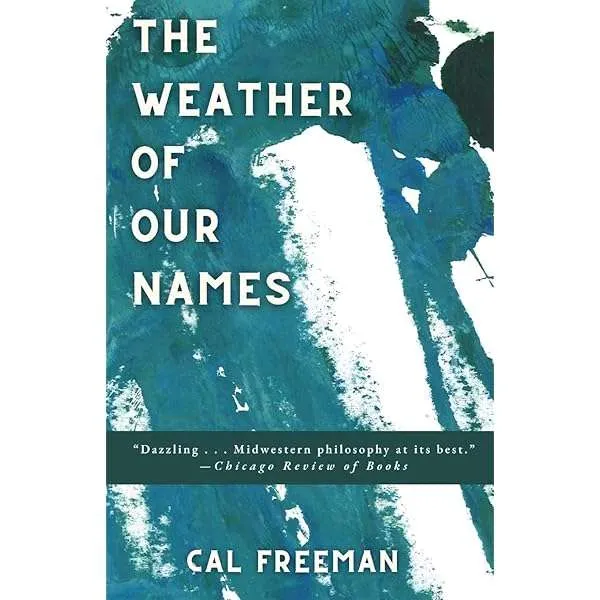
In Cal Freeman’s collection The Weather of Our Names, the writing flows from the personal (the death of his father, the elusive presence of his mother, and that of his two grandfathers) to the collective (specific landmarks gracing the spare landscape of Michigan). Freeman seems to delight in water, sprinkling words like “petrichor”, “riparian”, and “runnel” into the lines of his poems and infecting the reader with his delight that James Joyce mentioned Lake Erie in Finnegan’s Wake. (The words Freeman chooses are precise, rare, and idiosyncratic; nearly every poem in this collection had me running to the dictionary!)
Cal Freeman’s poetics is a poetics of loss and the failure of language to describe what we see and feel. In “Annotations While Waiting for the Mail and Thinking of My Mother,” Freeman describes his mother being unable to speak and writes of a “metalanguage of tautology”; in fact, the whole poem is a collection of so-called “unsuccessful openings.” (Of course, as a reader, I take issue with this description, for each opening reads like the beginning of a poem or a Zen koan.) Tempting the reader with Golden Boy Donuts, as well as Polish and Lebanese treats, “The Epistle to the Donut Shop” reveals that the speaker’s “childhood is narrated by languages / I still don’t understand except in cadence and intent.” (Again, especially since I know Freeman is a successful musician who often performs in Southeast Michigan, I’d argue that this understanding of cadence and intent is already valuable in and of itself. “Cadence” is defined as “a musical chord sequence moving to a harmonic close or point of rest and giving the sense of harmonic completion”; thus, Freeman’s understanding of “cadence” is embodied in his performance. )
Yet Freeman’s musings on language are more than melancholy; they take the reader on a metaphysical investigation of language itself. In Four Quartets, T. S. Eliot describes “each venture / [as] a new beginning, a raid on the inarticulate.” Freeman’s poems are such “a raid on the articulate”; in “Derecho,” for instance, the speaker reveals, “How I meant to say has less to do / with botched intentions than the mystery of utterance itself.” This also reminds me of the line “I feel my fate in what I cannot fear” by Theodore Roethke, another Michigan poet. While respecting that mystery, the speaker nevertheless validates the mere act of writing and speaking when he ends the poem with, “How I hope we don’t become what we haven’t said.”
In his series of “Yelping the Tegmine” poems, Freeman guides the reader to decrepit landmarks in Southeast Michigan like the Huron River Inn, or Heck’s Bar, or the Bella Vista Hotel that nevertheless have more to offer than a crab sandwich or Lake Erie perch; what they hide in their cracked walls is a wealth of stories, idiosyncratic memories, and the odd revelation. Freeman’s poems mention Joyce more than once; indeed, Joycean epiphany is very close to Freeman’s idea of “grace through happenstance,” something as elusive as a picture of the moon the speaker texts to his wife right before his wife drops her phone in the water from a boat on Lake Erie. In “Dichotomy Paradox as a Non-Fungible Token” the speaker expresses a series of desires: he wants a different name, longs for a different flower, but even this desire for otherness expresses something adjacent to epiphany: “One would want to have a different life/ in clear, white snow and want a different bloom/ than the one created by the snow that February day.” These lines remind me of Wallace Stevens’s “For the listener, who listens in the snow, / And, nothing himself, beholds / Nothing that is not there and the nothing that is.” Similarly, Freeman’s desire for otherness alludes to a kind of liberating emptiness that is conjured to life by the surroundings.
Thus, the spare metaphysics of Freeman’s poems is intimately tied to the landscape of Southeast Michigan; keeping in line with the poet’s own frequent and playful inversions in The Weather of Our Names, the landscape becomes intimate through the quiet poetics of this collection. Freeman writes: “You can’t pray to your mother/ or your father the way you can / to a windward stretch of bay / overburdened by the sunlight.” And indeed, Port Hope, the “beleaguered fishing village” Freeman describes, becomes one of the many sites of crossover between the sacred and the mundane: singing at a cathedral and drinking at the Buccaneer, listening to Joni Mitchell’s Blue and ripping a sportscoat at that “crepuscular hour / before eulogy and song / when the towns across the bay / threw mini-replicas of themselves / into the water.”
How can you pray to a “windward stretch of bay”? Simone Weil once said that attention is a form of prayer; Freeman’s attention to his landmarks is painstaking, poignant, often nostalgic, but always precise. In a twist of the absurd and the metaphysical that surely would appeal to Freeman, Jorge Luís Borges once wrote in a short story, “Sometimes a few birds, a horse, have saved the ruins of an amphitheater.” Freeman thus seems to save Echo’s, Port Austin, Portofino, the Bella Vistas, and others from oblivion by throwing mini-replicas of them into his poems that wind like rivers into our consciousness.
The poems towards the end of the collection are paeans to emptiness, which is not a source of dread, but rather, a road towards lightness. In “Disambiguation with One Bird in the Hand,” Freeman writes, “To be that lithe, / to perch upon a hand / and feel the tremor / carry through the hollow legs.” This poem about “cradl[ing] a small creature in your hands” is also the setting for the speaker putting his father’s ashes into a crypt. The litheness, the tremor, and the empty space all come together to carry a palpable sense of grief.
In the final poem “Grammar of the Birds,” , Freeman reveals, “I’ve been a hopeless birder / of disembodied song.” Yet as I’ve tried to show here, his poetics are anything but disembodied, for they bring together places and people bound for extinction but nevertheless firmly rooted in the speaker’s mind and heart. The same poem and the collection as a whole end with the following lines: “…we become / what we cannot look / forward to, the way / a gastropod coils around / itself what is and is not / itself only to be plucked / through its aperture like light.” In these seven lines, Freeman yokes together a vision of the (collective) future with the present moment, the image of a snail and its spiral, and of a final escape or freedom. Vladimir Nabokov once said, that “Tthe spiral is a spiritualized circle. In the spiral form, the circle, uncoiled, has ceased to be vicious; it has been set free.” Thus, in Freeman’s last poem, words spiral out of their conventional meaning; concrete places and times veer towards the abstract , and take the reader on a flight that is vertiginous because it makes us face ourselves and then ultimately sets us free. (At least while we keep reading, examining, and looking into the water at one of the waterfront restaurants at Lake Erie while having some perch.)