By Wendy Arons
Noises Off (written in 1982 by playwright Michael Frayn, now playing in its 2000 revised version at the Pittsburgh Public Theater) might best be described as a theatrical machine for producing silliness. I choose that word deliberately: “silly” derives from the Old English “seely,” which meant happy, blissful, or blessed, and it is pure bliss indeed to be made to laugh the way this play can make you laugh, particularly in these times when the escape into laughter feels like such a blessed relief.
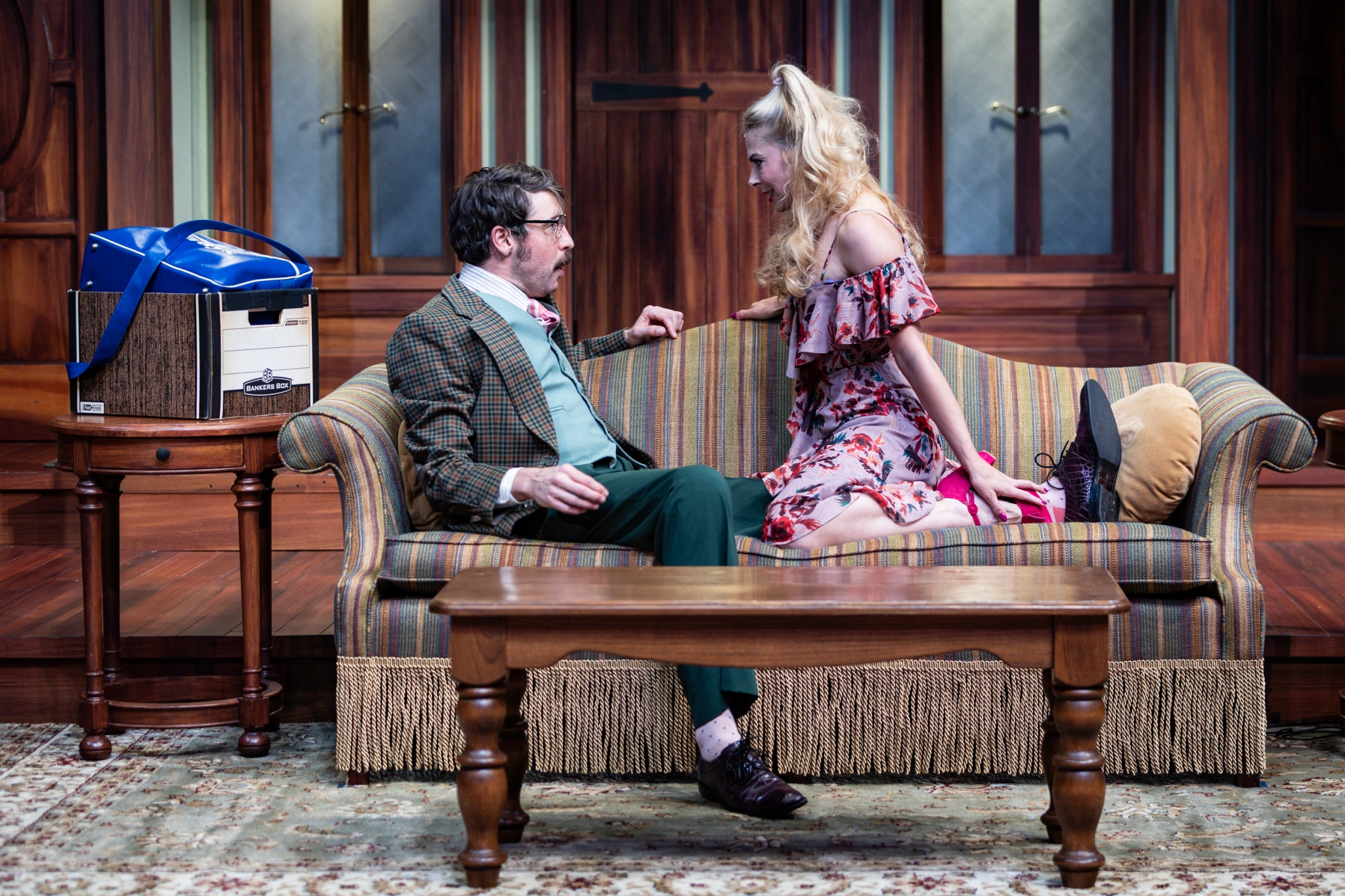
In Noises Off we witness the wild ride, over three acts, of a group of actors in a regional tour of a production of a new play. Act one opens on the final “technical” rehearsal of a (fictional) new comedy called Nothing On at a small theater in Weston-Super-Mare, UK. The actors in the ensemble have had only two weeks to rehearse this complicated show, which appears to be a rather lightweight sex farce of the sort popular in Britain in the mid-twentieth century, with myriad doors, identical boxes and bags and plates of sardines, nudge-nudge-wink-wink euphemisms for sex, and a blonde bombshell running around in lingerie and heels. It’s midnight before opening night, and the production is not in very good shape. Dotty (Linda Mugleston), the veteran actress who plays Mrs. Clackett, a housemaid, can’t keep her props straight; Frederick (Ricardo Vila-Roger), the actor who plays the tax-evading homeowner Philip Brent, is in a fragile emotional state, having just been left by his wife; everyone has to keep an eye on Selsdon (Wali Jamal) to make sure he doesn’t hit the bottle and forget his entrance as the burglar; Tim (Matt Henderson), the tech director and understudy, hasn’t slept in forty eight hours and can’t keep up with all of the technical snafus arising on set; and offstage amours among the company – in particular, the December-May romance between Dotty and her new beau, young leading man Garry Lejeune (Jeremy Kahn), as well as director Lloyd Dallas’s (Rowan Vickers) romantic involvement with two of the women in the company – are complicating the onstage business.
This first act of Noises Off, which offers a glimpse at what Act One of Nothing On could be if the fictional actors could pull all the tenuous plot and action threads together and make the show work, is a comic delight in its own right, sending up both the conventions of farce as a genre and the vanities and sensitivities of the fictional production’s creative team. The vapid plot of Nothing On threatens to collapse under even the slightest pressure of scrutiny: for example, when Frederick starts to question why his character would carry a box of groceries into the study to check on his mail, the prime reason offered is that the prop needs to be in the study when the burglar comes to rob the house – that is, the mechanism of the play, rather than a motivation of the character, is what drives the character’s actions. Or as Lloyd puts it: “Doors and sardines…getting the sardines on – getting the sardines off. That’s farce.” Moreover, relationships among the company are already starting to show a bit of strain, as evidenced by the passive-aggressive overuse of the endearments “love” and “pet” as their patience is taxed by each others’ needs and idiosyncracies.
But the comedy of this play really ratchets into high gear after the intermission. In the second act, it’s a month later, and the show is now on tour. Once again, we see the first act of Nothing On, but this time from behind the scenes (the set rotates to reveal the backstage area). We get the impression that the ensemble may have pulled the threads of the play together at some point in the intervening weeks, but now it’s all unravelling. Garry and Dottie are having a furious lover’s quarrel because the jealously possessive Garry believes Dottie is cheating on him with Frederick; Lloyd has secretly arrived from another gig, hoping to get in a weekend of canoodling with the farce’s blonde bimbo Brooke (the wonderful Lara Hayhurst); Poppy (Saige Smith), the stage manager and Lloyd’s jilted girlfriend, needs to talk to Lloyd about something important (not hard to guess what that could be); and on top of it all Selsdon has access to a bottle of whisky, which must be kept from him at all costs. Uproarious chaos ensues backstage as the members of the company, led by the overinvolved Belinda (Gwendolyn Kelso), try to cope with the various acts of sabotage and violence that Garry and Dottie inflict on each other and on Frederick and Brooke, all of which have disastrous consequences for the action onstage that we can hear and imagine, but not fully see. The third act, taking place two months later, reveals the effects, now again from the audience’s perspective, of the continued escalation of the ensemble’s infighting. By this point there is virtually “nothing on” stage anymore at all; the touring play has devolved into an incoherent mess in which some of the actors (mainly, the veterans Dottie, Garry, and Belinda) gamely attempt to improvise in response to the nonsensical appearance and disappearance of various props, objects, and people while others (namely, Brooke) doggedly stick to the script and blocking, producing ludicrous dissonance.
Noises Off is a delicate and complicated machine of a play, and director Margot Bordelon has assembled its many moving parts with finesse. Her direction strikes a fine balance between broad physical comedy and genuine stakes, without which the comedy would not land, and she manages the energy of the production beautifully – it keeps building steam from act to act as the touring farce becomes more and more chaotic. Her timing, too, is exquisite: for example, there’s a beautiful moment in the first act in which Selsdon misses his cue, and the amount of time we wait watching an empty, quiet stage is comedically perfect.
This show also requires its ensemble of actors to pull off the trick of playing an excellent farce in which they also play actors who can’t manage to keep a tepid farce on track. Just as the first act reveals, in a kind of meta way, that the driving force of Nothing On is the mechanism of the farce genre itself, so the comedy of Noises Off depends on letting the audience see how the machine of the play-within-a-play sweeps the hapless but well-meaning fictional actors into its gears – all the while keeping the real actors in full control of the physical comedy and timing of both comic worlds (the “real” world of the play’s actors, and the “farcical” world of Nothing On). The PPT ensemble is universally adroit with the sardine-slinging and door-slamming (with some particularly brilliant comic lazzi from Hayhurst, Kahn, and Vila-Roger) and they keep the blissful silliness coming at you with clockwork precision.